Service page vs blog post: matching each keyword to the right page
Some keywords need a service page, others need a blog post. Here is how to read search intent and the results page so every keyword lands on the right type of page.

On this page (9 sections)
- 1Why the page type matters
- 2The four types of search intent
- 3Read the results page before you decide
- 4Our decision table: intent to page type
- 5Worked examples (hypothetical)
- 6How to avoid keyword cannibalisation
- 7Make service pages and blog posts work together
- 8A quick routine for every new keyword
- 9Sources
You have a keyword list, and for each term you must choose: service page vs blog post. Some terms sound like questions, some sound like buyers, and some could go either way. The common mistake is to write a blog post for a keyword that wants a service page, or to stretch a service page to answer a question nobody asks it.
This post shows how to decide, one keyword at a time. You will learn the main types of search intent, how to read the results page to confirm what Google expects, how to avoid two of your own pages competing, and how to use a simple decision table. All examples are hypothetical and clearly labelled.
Why the page type matters
The page type matters because Google tries to show the kind of page that satisfies the search, not just pages containing the words. A brilliant service page rarely ranks for "how to file GST returns", and a brilliant guide rarely ranks for "GST consultant in Pune".
Getting this wrong wastes effort in two ways. The page underperforms, and you may write a second page later that competes with the first. If you have already done your keyword research, mapping each keyword to a page type is the next step before anything gets written.
The four types of search intent
Search intent is the reason behind a search. Most SEO tools group it into four types, and each one points towards a different kind of page.
Semrush describes the four types as informational (learning something), navigational (reaching a specific site or page), commercial (comparing options before deciding) and transactional (ready to buy, book or sign up).
- Informational: "what is technical SEO", "how to reply to a bad review". Usually a blog post or guide.
- Navigational: a brand name or "brand login". Usually your home page or the specific page they named.
- Commercial: "best accounting software for small business", "SEO agency vs freelancer". Often a comparison post, but sometimes a service page if results show providers.
- Transactional: "hire SEO agency Mumbai", "book physiotherapist near me". Almost always a service, product or booking page.
Google uses its own labels. The Search Quality Rater Guidelines (September 2025 version) group intent into Know, Do, Website and Visit-in-person queries. The names differ, but the idea is the same: work out what the searcher wants to happen next.
Keyword research table
Read the results page before you decide
The quickest way to confirm intent is to search the keyword yourself and look at what ranks. Google has already tested what people click, so the first page is strong evidence of the page type it expects.
A five-minute SERP check
- Search the keyword in a private window, set to the country you target.
- Note the type of each of the top ten organic results: service page, product page, blog post, guide, directory, video or forum thread.
- Note the features at the top: a map pack suggests local service intent, an AI Overview or "People also ask" box suggests questions, and shopping or ads suggest buying intent.
- Count the types. If seven or more results are one type, follow the majority.
- If the page is split, the intent is mixed. Decide which half you can realistically compete with, or plan two pages for two distinct intents.
Intent can shift over time. Semrush's study of AI Overviews found that 91.3% of the queries triggering them were informational in January 2025, falling to 57.1% by October 2025 as more commercial and navigational searches showed them (Semrush). Repeat the check for important keywords every few months.
Our decision table: intent to page type
Use the table below as a starting point, then let the SERP check overrule it when the evidence disagrees. We built it by lining up the four intent types Semrush describes against the rater guidelines' intent labels, then adding the SERP signals listed above; you can repeat the method with any intent model you prefer.
| Intent | Typical wording | Rater guideline label | SERP signals | Page to create |
|---|---|---|---|---|
| Informational | what, how, why, guide, ideas, examples | Know | Guides, AI Overview, People also ask | Blog post or guide |
| Commercial | best, vs, review, alternatives, cost of | Know or Do | Comparison posts, review sites, some providers | Comparison post, or service page if providers dominate |
| Transactional | hire, buy, book, agency, services, quote | Do | Service and product pages, ads | Service, product or booking page |
| Local transactional | near me, in [city] | Visit-in-person | Map pack, local service pages | Location service page plus Google Business Profile |
| Navigational | brand name, login, contact | Website | The brand's own pages | Home, contact or the named page |
Two rules sit on top of the table. First, if a keyword contains a price or cost question, check the SERP carefully: some show guides explaining cost drivers, others show providers. Second, never force one page to serve two intents just to save writing time.
Worked examples (hypothetical)
These examples are invented to show the method. They are not client cases, and real results pages will vary by location and over time.
Example 1: an accounting firm
A hypothetical firm has three keywords: "how to register for GST", "GST registration consultant" and "GST registration consultant in Pune". The first is informational, so it becomes a step-by-step blog post. The second and third are transactional; the city version also expects a map pack, so it becomes a location service page backed by a Google Business Profile.
Example 2: a software company
A hypothetical HR software company targets "best payroll software for startups". If the SERP shows mostly comparison articles, a comparison post is the right format, linking to the product page. If the SERP showed mostly vendor product pages, the product page itself would be the better target.
Example 3: a mixed keyword
"Website redesign cost" might show half guides and half agency pages. A sensible plan is a guide that explains the cost drivers, and a service page targeting "website redesign services", with the guide linking to the service page.
How to avoid keyword cannibalisation
Keyword cannibalisation happens when two of your pages target the same keyword with the same intent, so neither ranks as well as one combined page would. Two pages ranking for overlapping words is not automatically a problem.
Ahrefs makes this point clearly: the real issue is pages that share keywords and fulfil the same or very similar intent. It reports finding 9.7k cases of apparent cannibalisation on its own site, almost none of which needed fixing, because the competing pages served different intents.
How to spot it
- In Search Console, filter the Performance report by a query and switch to the Pages tab. Two or more of your pages taking turns for the same query is the warning sign.
- Look for blog posts whose title reads like a sales page, such as "Best SEO services in Delhi" sitting on the blog while a Delhi service page also exists.
- Check your keyword map. Each primary keyword should have exactly one target page.
How to fix it
- Pick the stronger page: the one that ranks better and has more valuable links.
- Merge the useful content from the weaker page into it.
- Redirect the weaker URL to the stronger one with a permanent redirect. Google Search Central lists redirects as the strongest signal for consolidating duplicate URLs, with rel="canonical" as a weaker hint.
- Update internal links so they point at the surviving URL.
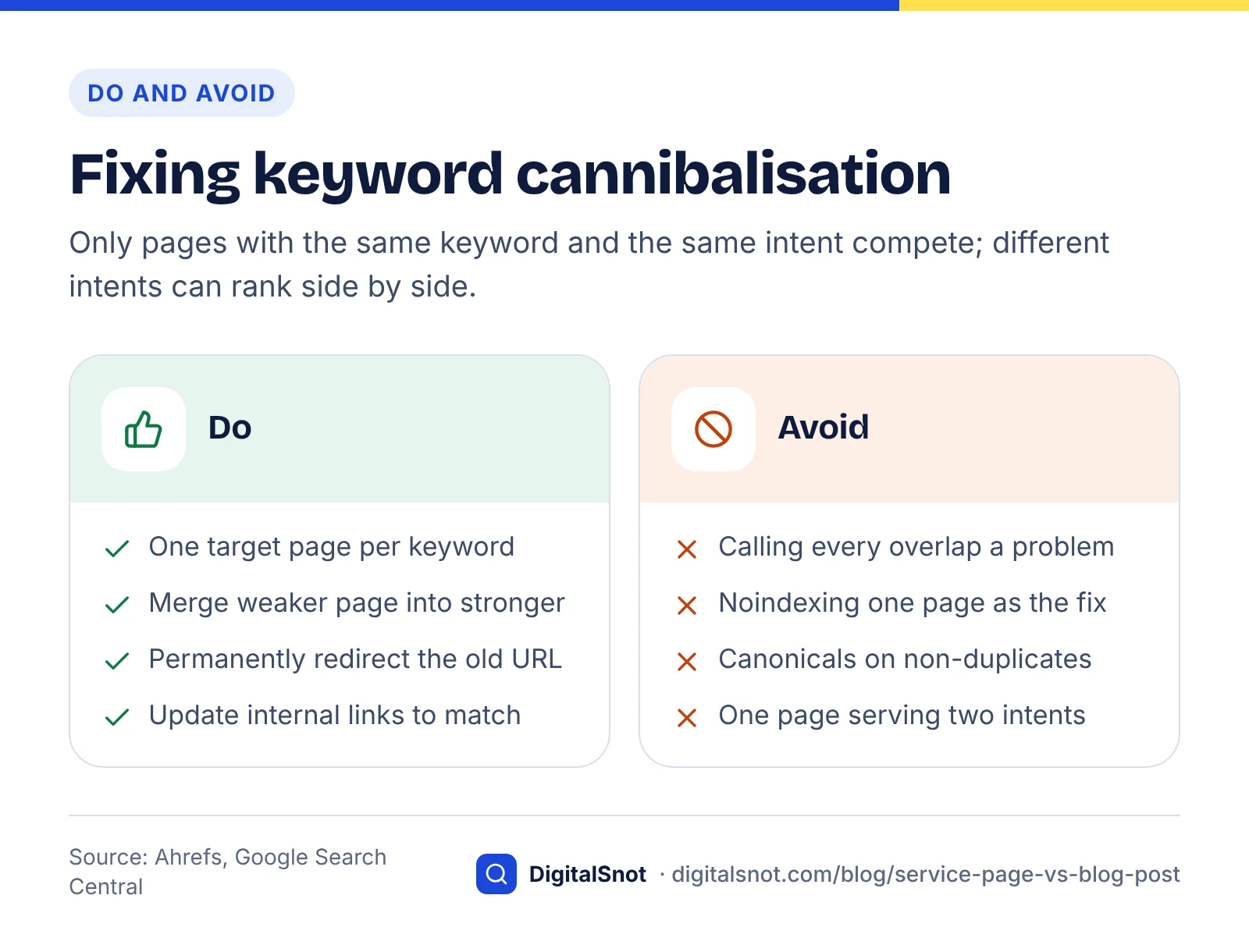
Avoid noindexing one of the pages as a fix. Ahrefs describes noindex as a poor way to handle cannibalisation, and says canonical tags only suit near or exact duplicates.
Search snippet being optimised
Make service pages and blog posts work together
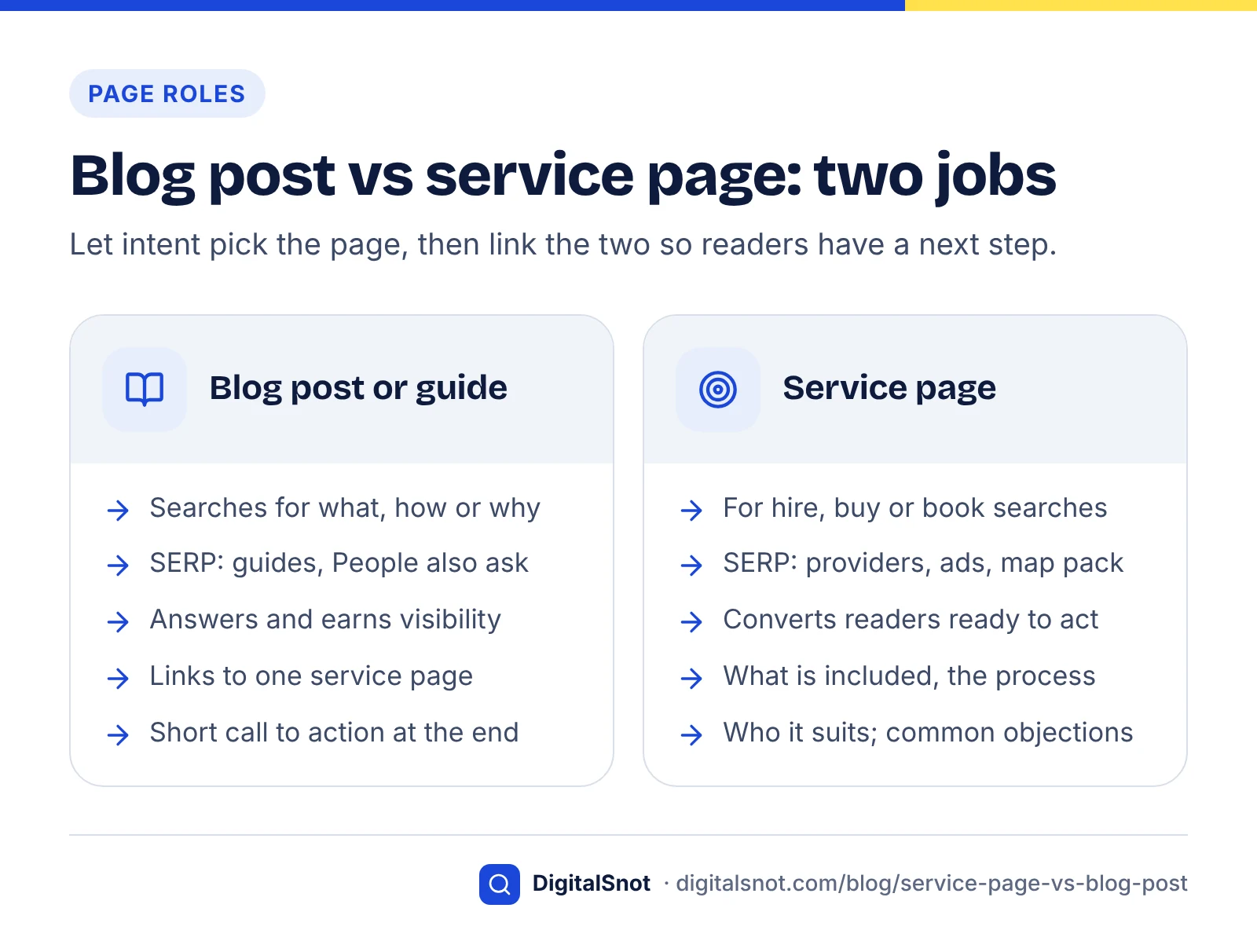
Blog posts and service pages are a team, not rivals. The post answers the question and earns visibility; the service page converts the reader who is ready to act.
- Link each blog post to the one service page it supports, using descriptive anchor text such as "our content SEO service" rather than "click here".
- Keep sales content off informational posts. A short, relevant call to action at the end is enough.
- Give service pages the substance buyers want: what is included, the process, who it suits and answers to common objections. Our on-page SEO checklist covers titles, headings and internal links for both page types, and our schema markup guide explains which structured data suits location pages, service pages and posts in 2026.
- Answer questions in clear, self-contained paragraphs. That helps both classic results and AI answers, as our guide on getting cited in AI search explains.
A quick routine for every new keyword
Run every new keyword through the same short routine before you brief a writer. It takes a few minutes and prevents most mapping mistakes.
Intent to page type in five steps
- Label the intent from the wording: informational, commercial, transactional or navigational.
- Run the SERP check and record the dominant page type.
- Check your keyword map for an existing page with the same intent. If one exists, improve it instead of writing a new page.
- Choose the page type from the decision table.
- Plan the internal link: which service page will this post support, or which posts will feed this service page?
If you would rather have someone build the keyword map and page plan for you, our on-page SEO work starts with exactly this exercise. When you are ready to talk it through, get in touch.
By the numbers
- of queries triggering AI Overviews had informational intent in January 2025 (Semrush study of 10M+ keywords)
- 91.3%
- Source: Semrush
- of queries triggering AI Overviews had informational intent by October 2025, as commercial and navigational shares grew
- 57.1%
- Source: Semrush
- cases of apparent keyword cannibalisation Ahrefs found on its own site, almost none of which needed fixing
- 9.7k
- Source: Ahrefs
Frequently asked questions
Should a keyword go on a service page or a blog post?
It depends on search intent. If people want to learn something, such as how to do a task or what a term means, use a blog post or guide. If they want to hire, buy or book, use a service or product page. Search the keyword and check what types of pages already rank, then follow the majority unless you have a strong reason not to.
What is search intent in SEO?
Search intent is the reason behind a search: what the person hopes to find or do. It is usually grouped into four types: informational, navigational, commercial and transactional. Google's own rater guidelines use similar labels called Know, Do, Website and Visit-in-person. Matching your page type to the intent is one of the most important on-page decisions.
Can a blog post rank for commercial keywords?
Yes, when the results page shows that searchers want comparisons or reviews before choosing. Keywords like "best payroll software" or "agency vs freelancer" often rank blog-style comparison pages. If the top results are mostly provider service pages instead, a blog post will struggle, and a service page is the better target for that keyword.
What is keyword cannibalisation?
It happens when several pages on your site target the same search term. They compete with each other and none ranks as well as one strong page would. We fix it by giving each page a clear focus and merging or redirecting where needed.
How do I fix keyword cannibalisation?
Choose the stronger page, usually the one with better rankings and more valuable backlinks. Merge useful content from the weaker page into it, then permanently redirect the weaker URL to the stronger one and update your internal links. Avoid using noindex as the fix, and keep canonical tags for pages that are true or near duplicates.
Do I need both a service page and a blog post for the same topic?
Often, yes, but they should target different intents. A guide can target the informational question, such as how much a website redesign involves, while the service page targets the buying search, such as website redesign services. Link the guide to the service page so readers who are ready to act have a clear next step.
Sources
Every figure and claim in this article comes from the sources below. We checked each one when writing and link to the original so you can read it yourself. Credit belongs to the authors and publishers listed. How we write and check our articles.
-
1
4 types of keywords in SEO (+ examples)
Semrush · Definitions of informational, navigational, commercial and transactional intent
-
2
Search Quality Rater Guidelines (General Guidelines, September 2025)
Google · Google's intent labels: Know, Do, Website and Visit-in-person queries
-
3
Semrush AI Overviews Study: What 2025 SEO Data Tells Us About Google's Search Shift
Semrush · Share of AI Overview queries with informational intent, January vs October 2025
-
4
Keyword Cannibalization: What It (Really) Is & How to Fix It
Ahrefs · Definition of cannibalisation, the 9.7k cases figure and recommended fixes
-
5
How to Specify a Canonical with rel="canonical" and Other Methods
Google Search Central · Redirects as the strongest consolidation signal; canonical as a hint