Sale discounts that do not eat your margin
Work out how many more units a discount needs you to sell, price a sale honestly against the MRP, and handle GST on discounts, buy one get one free, free gifts and coupons.
On this page (9 sections)
A festival sale can bring more orders and a thinner profit margin at the same time. This post shows you how to work out how many more units a sale discount needs you to sell, how to price a sale honestly against the MRP, how GST treats discounts, buy one get one free and free gifts, and how to run coupon codes without losing track of them.
The numbers in the worked example are made up, and the GST rate in it is not a ruling on any product. This post is not legal or tax advice: check the GST on your offers and your price claims with your CA or lawyer.
A discount comes out of your profit
Your profit on one sale is the price before GST, minus what the product costs you, minus what you pay on every order, such as packing, delivery and fees. When you cut the price, those costs stay the same. So the whole discount comes out of your profit, not out of your price.
That is why a small discount can need a lot of extra sales. Take a product that sells for ₹1,000 before GST and costs you ₹600. It earns ₹400 a sale. At 20% off it sells for ₹800 and earns ₹200, so you need twice as many sales, 100% more, just to earn the same profit.
The sum for any offer is:
- Extra sales needed = profit per sale at full price ÷ profit per sale after the discount − 1.
- Break-even discount = the discount at which a sale only just covers the product and the per-order costs. It equals your margin after those costs. Beyond it, every sale loses money, however many you make.
A worked example: one bedsheet set
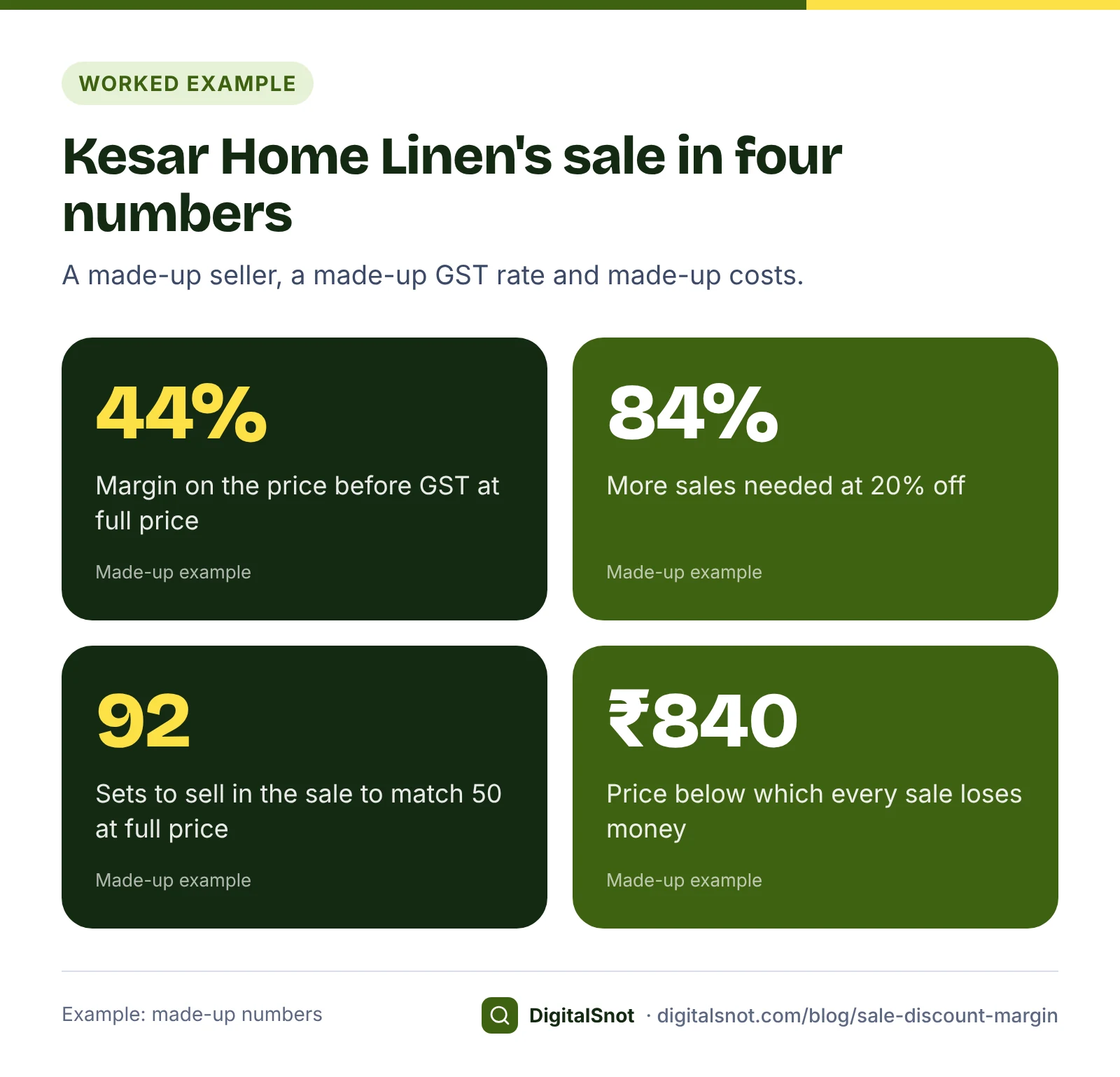
Kesar Home Linen in Panipat is a made-up seller with a cotton bedsheet set at an MRP of ₹1,499, including GST at a made-up 5%. The price before GST is ₹1,427.62. The set costs the owner ₹700, and packing and delivery cost ₹100 an order, both without GST because she claims input tax credit. Her profit at full price is ₹627.62 a sale, a 44% margin on the price before GST.
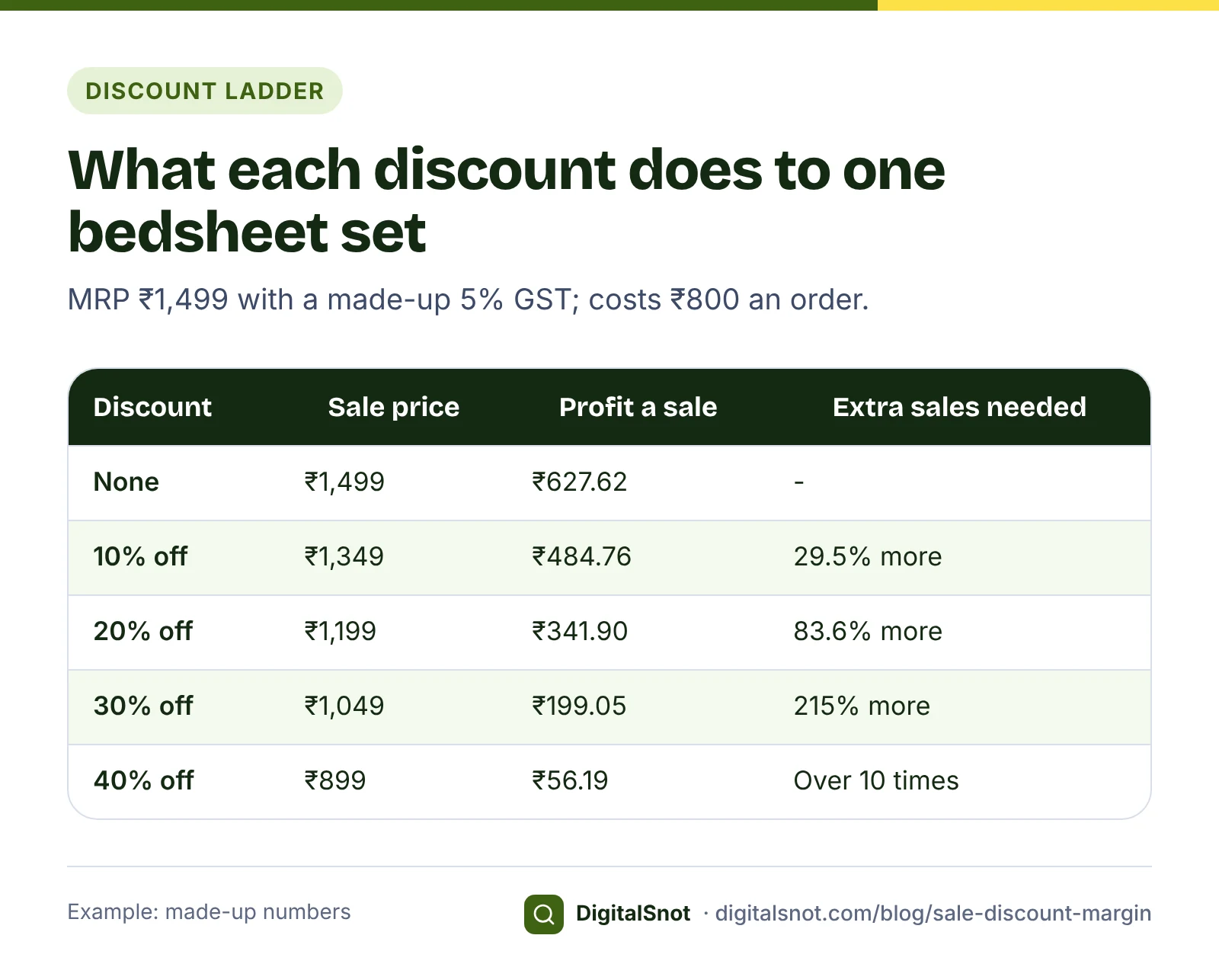
At 20% off, the price is ₹1,199 (rounded down so the claim stays true) and the profit falls to ₹341.90. If she sells 50 sets a month at full price, the sale has to sell about 92 sets to earn the same profit. At 30% off she needs more than three times her usual sales. At about 44% off, the price before GST only covers her ₹800 of costs, and below ₹840 she loses money on every set.
Put your own price, cost and offer into the Discount & Offer Profit Calculator. It takes GST out of prices that include it and shows the profit on each sale, the extra sales the offer needs, the discount at which you stop making money and a ladder of common discounts, for a percentage off, a flat amount off, buy one get one free or a free gift. It counts gross profit only, and how many more buyers an offer brings is your own estimate.
Check the costs a sale adds
The sum above is the best case. Before you pick a discount, add what a sale changes:
- Marketplace fees. A percentage commission falls with the price, but closing or fixed fees, which are set by price band, and shipping fees fall little or not at all, so they take a bigger share of a sale price. Our post on your real profit per order lists every fee line, and the Marketplace Fee and Profit Calculator works out your payout at the sale price.
- Sales you would have made anyway. Regular buyers who would have paid full price now pay less. That is lost profit, not extra sales.
- Ads and returns. More ad spend and more returns during a sale both raise your cost per order.
Our suggestion: discount the products with the healthiest margins, keep thin-margin products at full price, and pick the smallest discount your buyers will notice.
MRP, "was" prices and honest sale claims
A sale price has to be true as well as profitable. Four rules matter most.
Never above the MRP
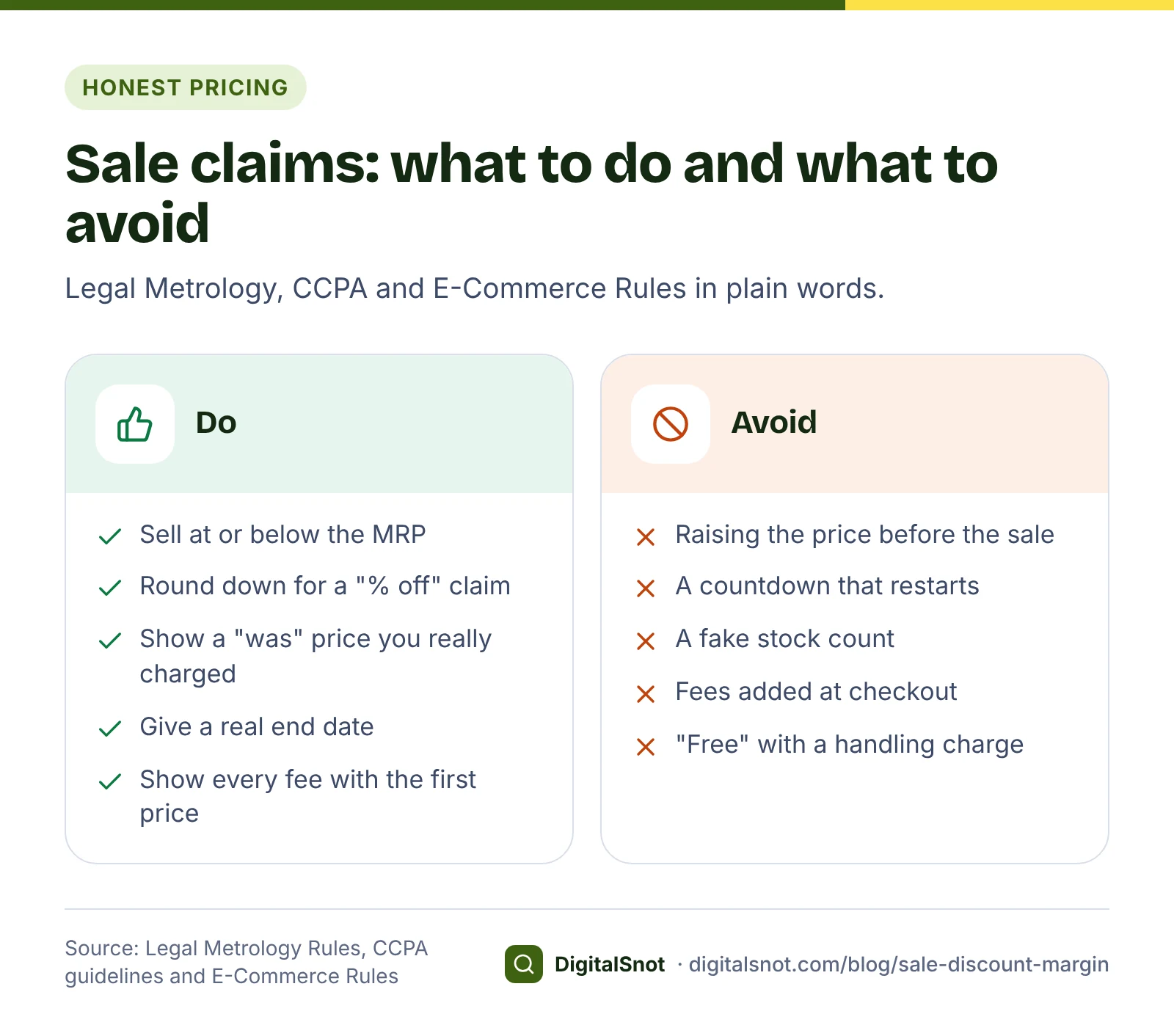
Rule 18(2) of the Legal Metrology (Packaged Commodities) Rules, 2011 says no one, including the manufacturer, packer, importer or retailer, may sell a pre-packed product above its retail sale price, the MRP printed inclusive of all taxes. Raising a price above the MRP before a sale, to show a bigger discount, breaks this rule.
The real discount on the MRP
The real discount is what the buyer saves against the MRP after every part of the offer. A ₹999 product at ₹799 with a ₹50 coupon on top costs the buyer ₹749: 25.03% off, not the 20% on the price tag. For a round claim, work back from the MRP and round down. 30% off ₹999 is ₹699.30, so sell at ₹699; ₹700 would be only 29.93% off.
The Discount and Sale Price Calculator works this out for a percentage off, an amount off, a sale price with a coupon, or buy X get Y. It shows the real discount on the MRP, the GST inside the price, your margin after the offer and the price to set for a round "% off", and its checks flag a price above the MRP, a claim that does not match the price, a countdown and fees added at the last step.
Only real "was" prices and "free" offers
The Consumer Protection Act, 2019 treats an advertisement that falsely describes a product, or deliberately hides important information, as misleading (section 2(28)). A struck-out price you never charged makes a deal look bigger than it is, so our rule is simple: show only a "was" price you really charged. For "free", the CCPA's 2022 guidelines on misleading advertisements say something is not free if the buyer pays packing or handling charges for it, or if the price of what they must buy was raised, or its quantity or quality cut, for the offer.
Real deadlines and the full price upfront
The CCPA's Guidelines for Prevention and Regulation of Dark Patterns, 2023 list 13 dark patterns. Two are common in sales: false urgency, such as a countdown that restarts or a stock count that is not real, and drip pricing, where parts of the price appear only at the end. The Consumer Protection (E-Commerce) Rules, 2020 also ask for the total price with a breakup of the charges. Our post on dark patterns your online shop must avoid covers all of them.
GST on discounts, buy one get one free and free gifts
Under section 15(3)(a) of the CGST Act, a discount given before or at the time of the sale and recorded in the invoice is not part of the taxable value, so GST is charged on the price after the discount. A discount given after the sale, such as a credit note or cashback, has its own conditions under section 15(3)(b); check those with your CA.
CBIC Circular 92/11/2019-GST covers the two offers sellers ask about most:
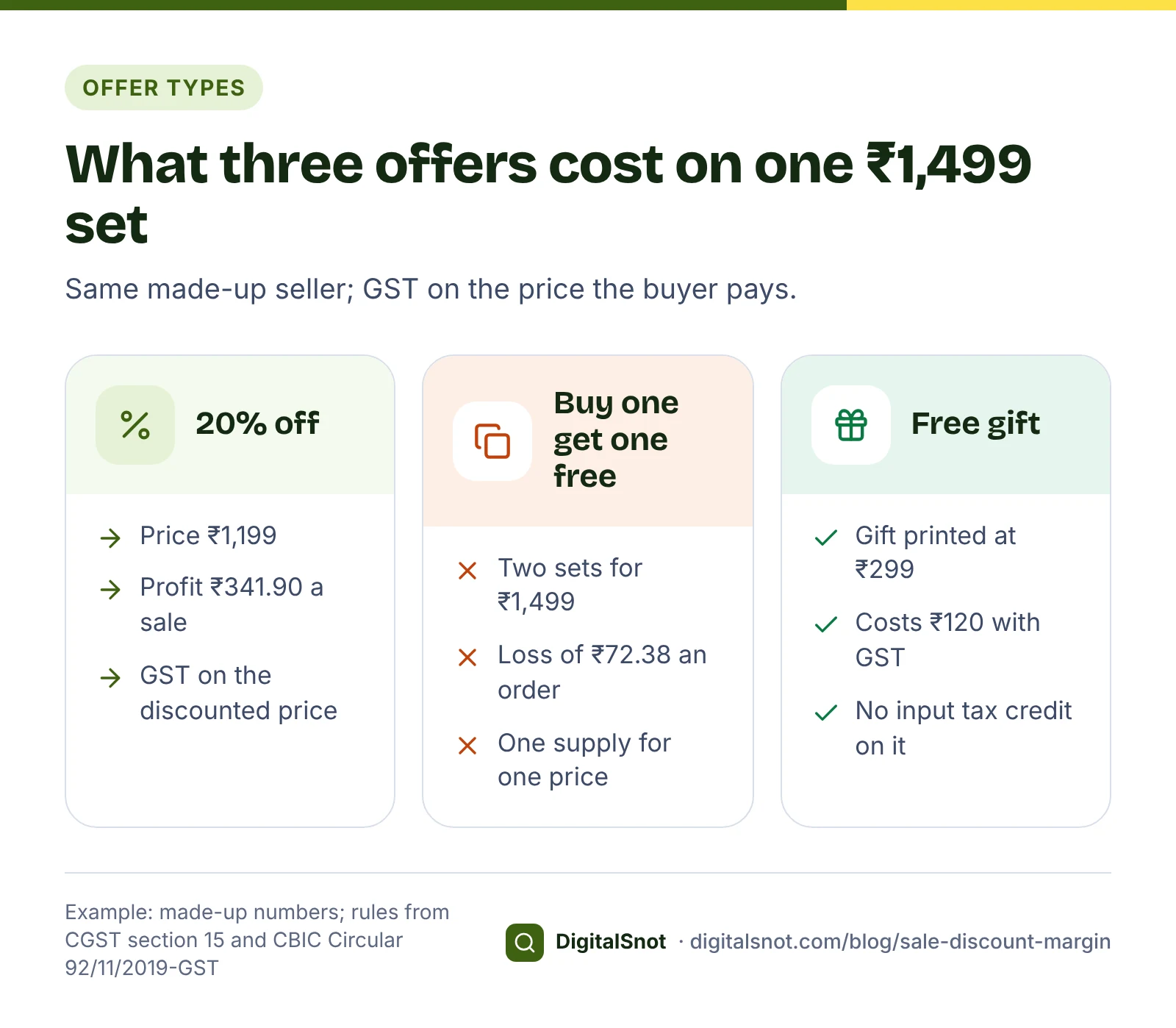
- Buy one get one free is not a free supply. The items are sold together for one price, so GST is on the price the buyer pays for the whole order. Where the items differ, whether the offer is a composite or a mixed supply decides the rate.
- Free gifts carry no input tax credit: you cannot claim back the GST on goods you give away free. So count a gift at its cost including GST.
Now compare the offers on the bedsheet set. Buy one get one free gives away half the price per unit, like 50% off: two sets for ₹1,499 leave ₹1,427.62 against ₹1,500 of costs, a loss of ₹72.38 an order. A free cushion cover printed at ₹299 that cost her ₹120 including GST takes ₹120 from her profit, while ₹299 off the price takes ₹284.76, because ₹14.24 of that ₹299 was GST.
Coupon codes that stay under control
A single public code is easy to share and hard to control. Unique codes let you limit each code to one use and see where your orders came from.
The Coupon Code Generator makes up to 10,000 unique codes at a time, from a prefix and random characters or a pattern such as DIWALI-XXXX-##, using your browser's own random numbers. Codes never repeat each other or a list of codes you already use, and it can leave out look-alike characters such as 0 and O. Fill in the discount, the minimum order, the dates and the limits to get the terms to show next to the codes, then download a CSV or TXT file or print coupon cards. It does not create the discount in your shop, so set the same terms there and test one code at checkout before you share the batch.
Remember that a coupon on top of a sale price is a second discount. Her ₹1,199 sale price with a ₹100 coupon is ₹1,099, 26.68% off the MRP, and leaves ₹246.67 a sale: she would need about 154% more sales than at full price. Give every code a real end date, and stop it on that date.
Mistakes to avoid
- Discounting every product by the same amount. Thin-margin products can lose money at a discount that suits the rest.
- Forgetting the GST inside the price. Work out profit on the price before GST.
- Raising the price before the sale. Never above the MRP, and never to fake a "was" price.
- Countdowns that restart. A fake deadline is false urgency.
- Stacking coupons on sale prices without checking. Work out the real discount and your margin on the final price.
Your next step
Before your next sale, list the products you plan to discount and run each through the Discount & Offer Profit Calculator with your real costs. Drop any product whose break-even discount is close to your offer, then set the sale prices in the Discount and Sale Price Calculator so every claim is true. All our free tools for online sellers are on one page, and if you want help planning a sale, get in touch.
Free tools in this article
- Discount & Offer Profit Calculator How many more sales a discount, BOGO or free gift needs to earn the same gross profit.
- Marketplace Fee and Profit Calculator Compare payout, profit and break-even price per order on Amazon.in, Flipkart, Meesho and your own shop.
- Discount and Sale Price Calculator See what the buyer pays, the real discount on MRP, the GST inside the price and your margin after an offer.
- Coupon Code Generator Make many unique discount codes, with the offer terms, CSV and TXT files and coupon cards to print.
By the numbers
- dark patterns specified in the CCPA's 2023 guidelines, including false urgency and drip pricing
- 13
- Source: PIB: Department of Consumer Affairs
Frequently asked questions
How do I work out how many more sales a discount needs?
Divide your profit per sale at full price by your profit per sale after the discount, and subtract one. A product that earns ₹400 at full price and ₹200 at 20% off needs 400 ÷ 200 − 1 = 100% more sales to earn the same profit. Use the price before GST in both.
What is a break-even discount?
It is the discount at which a sale only just covers the cost of the product and the costs you pay on every order. It equals your margin after those costs: a product with a 44% margin breaks even at about 44% off. At a deeper discount every sale loses money.
Can I sell above the MRP during a sale?
Not for pre-packed goods. Rule 18(2) of the Legal Metrology (Packaged Commodities) Rules, 2011 says no one, including the manufacturer, packer, importer or retailer, may sell a pre-packed product above its retail sale price. Raising the price above the MRP to show a bigger discount breaks this rule.
Is GST charged on the MRP or the discounted price?
When the discount is given before or at the time of sale and recorded in the invoice, section 15(3)(a) of the CGST Act leaves it out of the taxable value, so GST is on the discounted price. Discounts after the sale, such as credit notes, have their own conditions under section 15(3)(b).
How is GST worked out on buy one get one free?
CBIC Circular 92/11/2019-GST says buy one get one free is not a free supply: the items are sold together for one price, so GST is on the price the buyer pays. Where the items differ, whether it is a composite or a mixed supply decides the rate. Check your offer with your CA.
Can I claim input tax credit on free gifts?
No. CBIC Circular 92/11/2019-GST says input tax credit is not available on goods given away as free gifts. Count a gift at its cost including GST when you compare it with a discount.
Sources
Every figure and claim in this article comes from the sources below. We checked each one when writing and link to the original so you can read it yourself. Credit belongs to the authors and publishers listed. How we write and check our articles.
-
1
Legal Metrology (Packaged Commodities) Rules, 2011 with all amendments
Department of Consumer Affairs · Rule 18(2): no sale of a pre-packed product above its retail sale price; MRP inclusive of all taxes.
-
2
Consumer Protection Act, 2019
India Code · Section 2(28): an advertisement that falsely describes a product or deliberately conceals important information is misleading.
-
3
Guidelines for Prevention of Misleading Advertisements, 2022 (CCPA notification)
Department of Consumer Affairs · Guideline 7: when something cannot be called free, including packing or handling charges and raised prices.
-
4
CCPA issues Guidelines for Prevention and Regulation of Dark Patterns, 2023
PIB: Department of Consumer Affairs · 13 specified dark patterns, including false urgency and drip pricing.
-
5
The Guidelines for Prevention and Regulation of Dark Patterns, 2023 (Gazette)
Department of Consumer Affairs · Official definitions of false urgency and drip pricing.
-
6
Consumer Protection (E-Commerce) Rules, 2020 (Gazette)
Department of Consumer Affairs · The total price with a breakup of compulsory and other charges.
-
7
Section 15: Value of taxable supply
CBIC · Section 15(3)(a): discounts at or before supply recorded in the invoice are not part of the value; 15(3)(b) for later discounts.
-
8
Circular 92/11/2019-GST: sales promotion schemes
CBIC · Buy one get one free is not a free supply; no input tax credit on free gifts.