Marketplace listing checklist: titles, bullets, images and the details the law asks for
A field-by-field checklist for Amazon.in, Flipkart and Meesho listings: title and bullet rules, keywords without stuffing, photos, size charts and the declarations the law asks for.
On this page (11 sections)
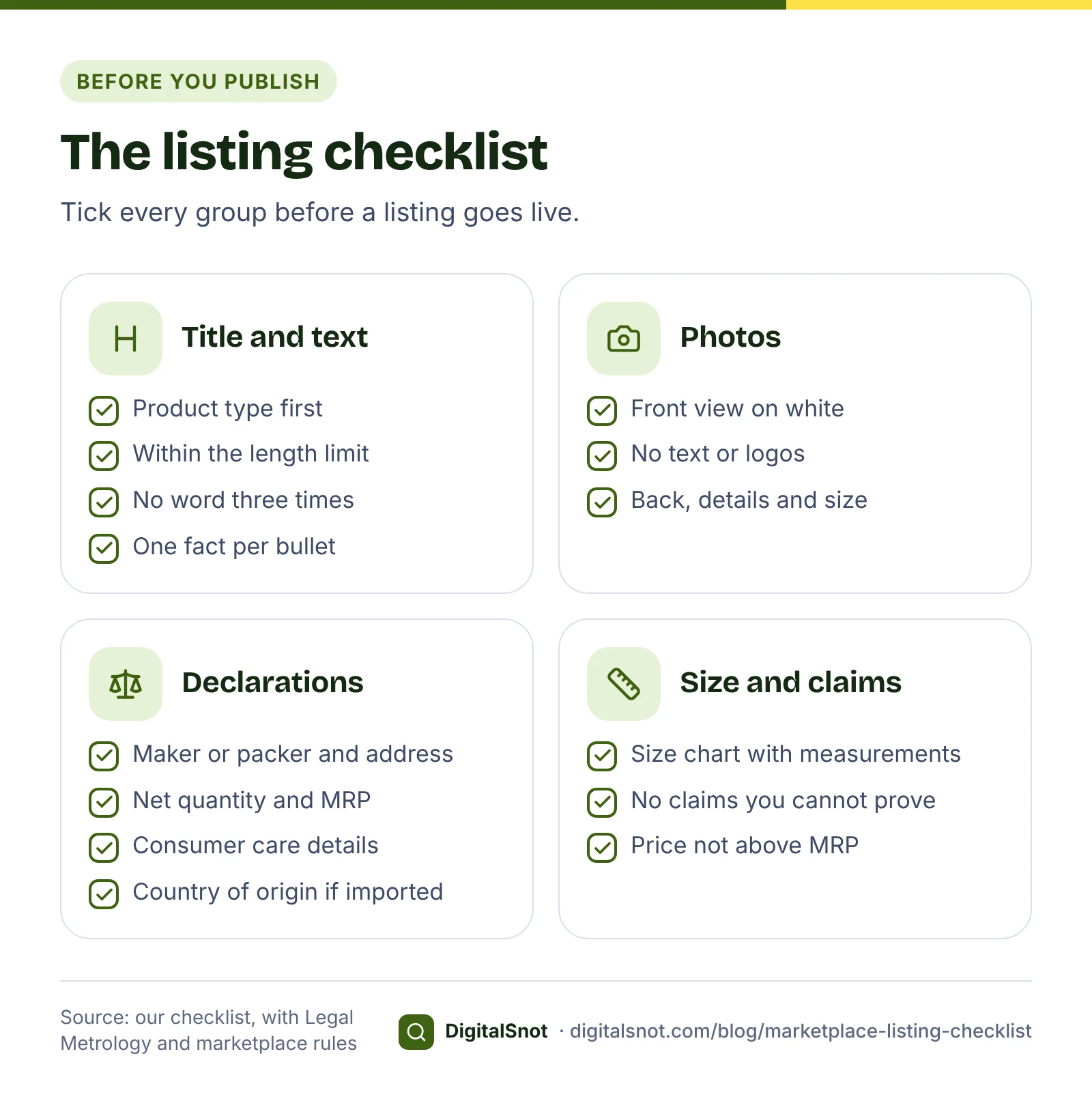
A listing does two jobs. It helps the marketplace show your product to the right buyers, and it tells those buyers everything they need before they pay. This post walks through a listing field by field: the title and bullet rules you can check, where keywords go, photos, size charts, the declarations the law asks for and the claims to leave out. Use it as a marketplace listing checklist before every new listing goes live.
Marketplaces change their rules and add more by category, so check the style guide for your category in Seller Central, Seller Hub or the Supplier Panel too. This post is not legal advice: check your own products with your lawyer, CA or the Legal Metrology office.
Gather the facts before you write
Most weak listings are weak because the facts were never collected. Before you write a word, put these on one sheet for each product (our checklist):
- The product type in plain words, the brand and the model or variant.
- Material, colour, size, weight or net quantity, and how many come in the pack.
- What it is for, who it suits, how to use it and how to care for it.
- Everything printed on the pack: maker or packer, address, MRP, dates and consumer care details.
- Measurements for a size chart, if you sell clothes or shoes.
- The words buyers type when they look for it.
Write each listing from this sheet, so Amazon.in, Flipkart, Meesho and your own shop all say the same thing.
Titles: the rules you can check
Amazon.in
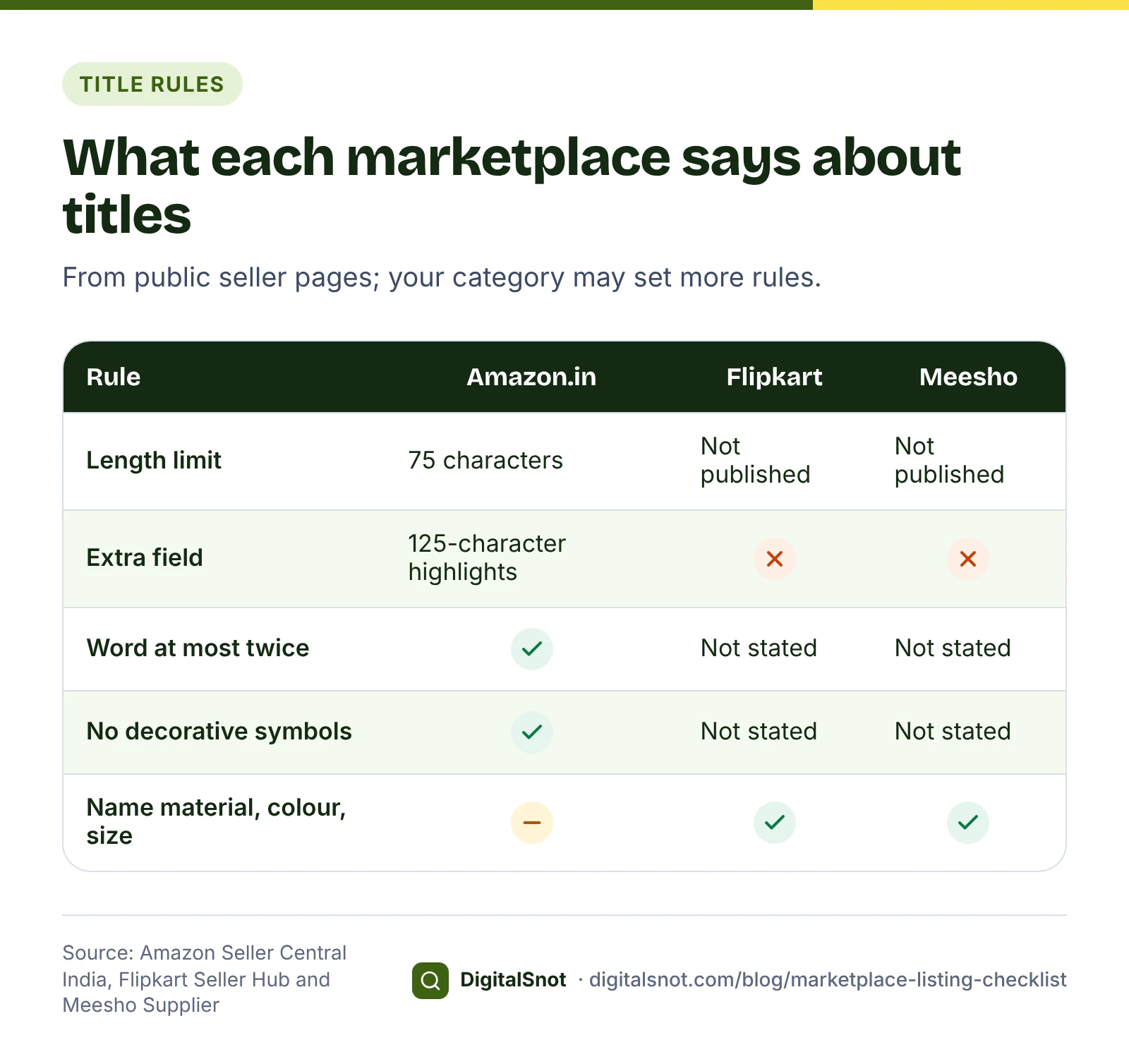
Amazon.in has announced that from 27 July 2026, titles in all categories except media must be 75 characters or less, including spaces. A new field, item highlights, gives you 125 more characters for materials or uses that help buyers compare. Titles still over 75 characters are being changed gradually to Amazon's own suggestion, and brand owners get 14 days to review the change first.
The title rules in force since 21 January 2025 still apply. A title may not use the same word more than twice, though prepositions, articles and conjunctions do not count. It may not use the characters ! $ ? _ { } ^ ¬ ¦ unless they are part of the brand name, and it should not carry promotional phrases such as "free shipping".
Flipkart and Meesho
Flipkart's listing optimisation guide asks for a short title built on the main search terms; its example names the material, colour and size. Its guide on how to list products warns against vague titles. Meesho's supplier page on selling kurtis lists the details it asks for, such as fabric, fit, size and pattern. Neither publishes a title length on its public pages, so a title under 75 characters that leads with the product type is our suggestion for both.
Bullets and description
On Amazon.in, the bullet points carry most of your selling. Amazon updated its bullet point rules from 15 August 2024 to restrict special characters, emojis and some phrases, such as guarantees of a refund. Write each bullet as one fact the buyer needs: what it is made of, its size, what it is for, how to use or care for it, and what comes in the box.
Flipkart's guides ask for detailed descriptions that are easy to scan, with keywords placed naturally, and for accurate specifications such as size, weight, colour and material, because wrong specifications lead to returns and poor reviews. Meesho's kurti page asks for a short, plain description, and lists price, GST percentage, HSN code and weight among the required details.
If you also sell from your own shop and list products on Google, Merchant Center's product data specification allows titles of up to 150 characters and descriptions of up to 5,000. Type your product sheet into the Product Description Builder to get title options, a short and a long description and bullet points from fixed templates, with checks for length, promotional text, capitals and claims that need proof. It uses no AI: the words are yours.
Keywords without stuffing
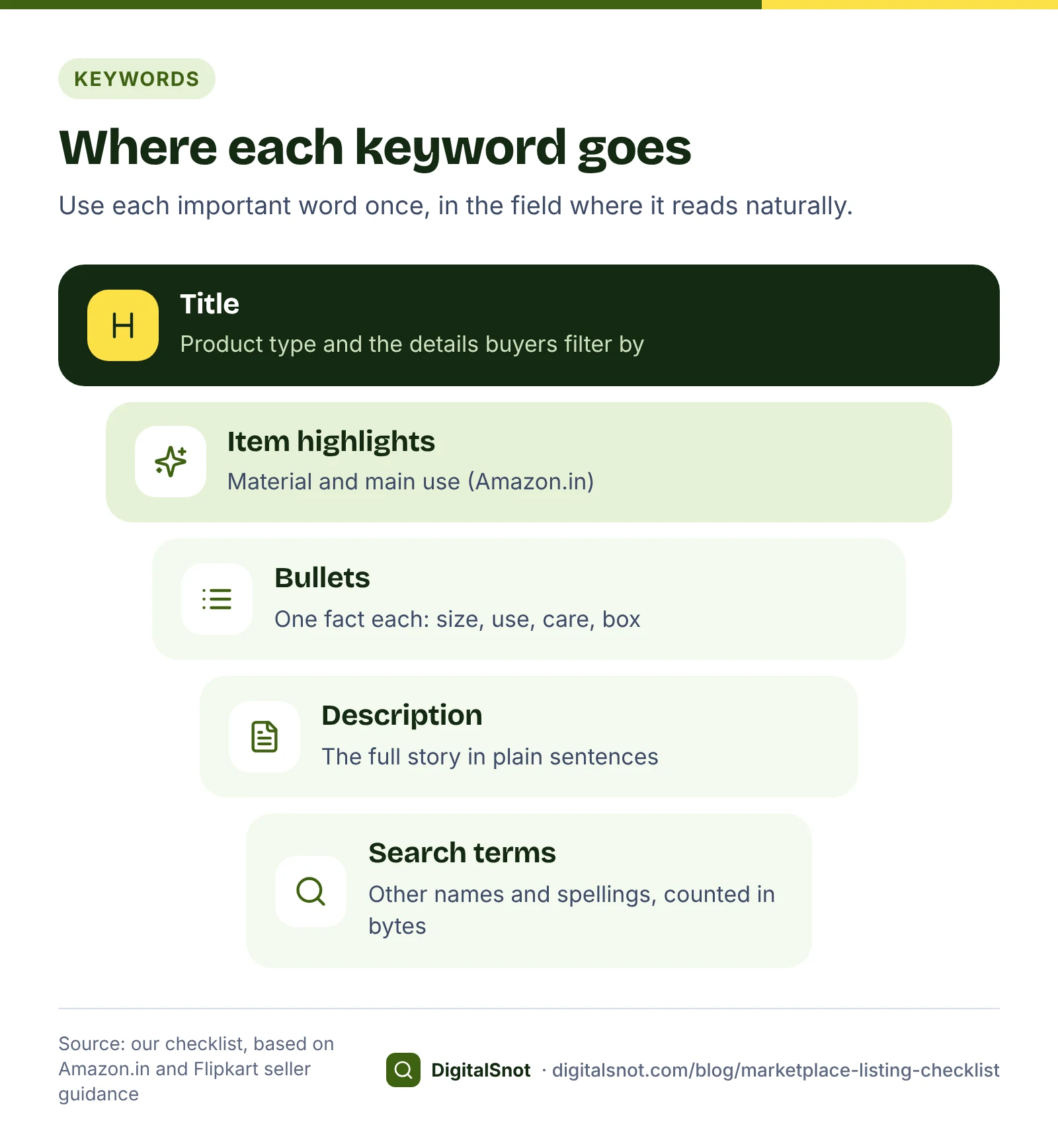
Buyers search with plain words, such as "turmeric powder 200 g" or "cotton kurti for women". Use each important word once, in the field where it reads naturally:
- Title: the product type and the one or two details buyers filter by.
- Item highlights and bullets: materials, uses and sizes, in sentences.
- Description: the full story, with the same words where they fit.
- Amazon search terms: other names, local names and spellings that are not already in the listing. Amazon counts this field in bytes, not characters, and a Hindi letter takes three bytes, so check the current limit in Seller Central.
Repeating a word to rank higher breaks Amazon's twice rule and makes the title harder to read. Paste your listing and your keywords into the Marketplace Listing Checker. It checks lengths, repeated words, capitals, special characters and promotional words against what each marketplace tells sellers, counts Amazon search terms in bytes, shows which keywords each field covers and gives you a tidied copy. For Flipkart and Meesho most of its checks are our checklist, and it says so.
Photos
The main image is the front of the whole product on white, with no text, logos, watermarks or props, and other images show the back, details, size and the product in use. Our post on product photo rules for marketplaces sets out each marketplace's figures, and the Product Photo Checker measures your photos against them in your browser.
The details the law asks for
If you sell pre-packed goods, the listing must carry the same declarations as the pack. Since 1 January 2018, under an amendment to the Legal Metrology (Packaged Commodities) Rules, goods on e-commerce platforms must show the name and address of the manufacturer, packer or importer, the name of the product, the net quantity, the MRP inclusive of all taxes and consumer care details. The Legal Metrology office has sent notices to e-commerce companies over missing country of origin declarations for imported goods.
The Consumer Protection (E-Commerce) Rules, 2020 point the same way: sellers must give the details buyers need to decide before they buy, including the country of origin. And rule 18(2) of the Packaged Commodities Rules says no one may sell a pre-packed product above its MRP, so check your listing price against the pack.
Type the declarations into the listing's detail fields, not only into a photo of the back of the pack, which is hard to read on a phone and cannot be searched. Our post on what must be printed on a product package lists every declaration, and the Package Label Checker tells you which are missing. Packed food has its own food safety labelling rules on top of these.
Size charts for clothes and shoes
A size label alone, such as M or 38, means different things to different brands. Even for garments sold loose or open, the 2022 amendment to the Packaged Commodities Rules asks for sizes such as S, M or L with measurements in centimetres or metres.
Measure your own samples, say whether the figures are body or garment measurements, and give both inches and centimetres. The Size Chart Builder converts between them exactly, builds an HTML table for your own shop and a PNG image for marketplaces that take a size chart picture, and flags missing figures and sizes that do not grow. Marketplaces have their own size chart templates in their seller panels, so use those where they exist.
Honest claims
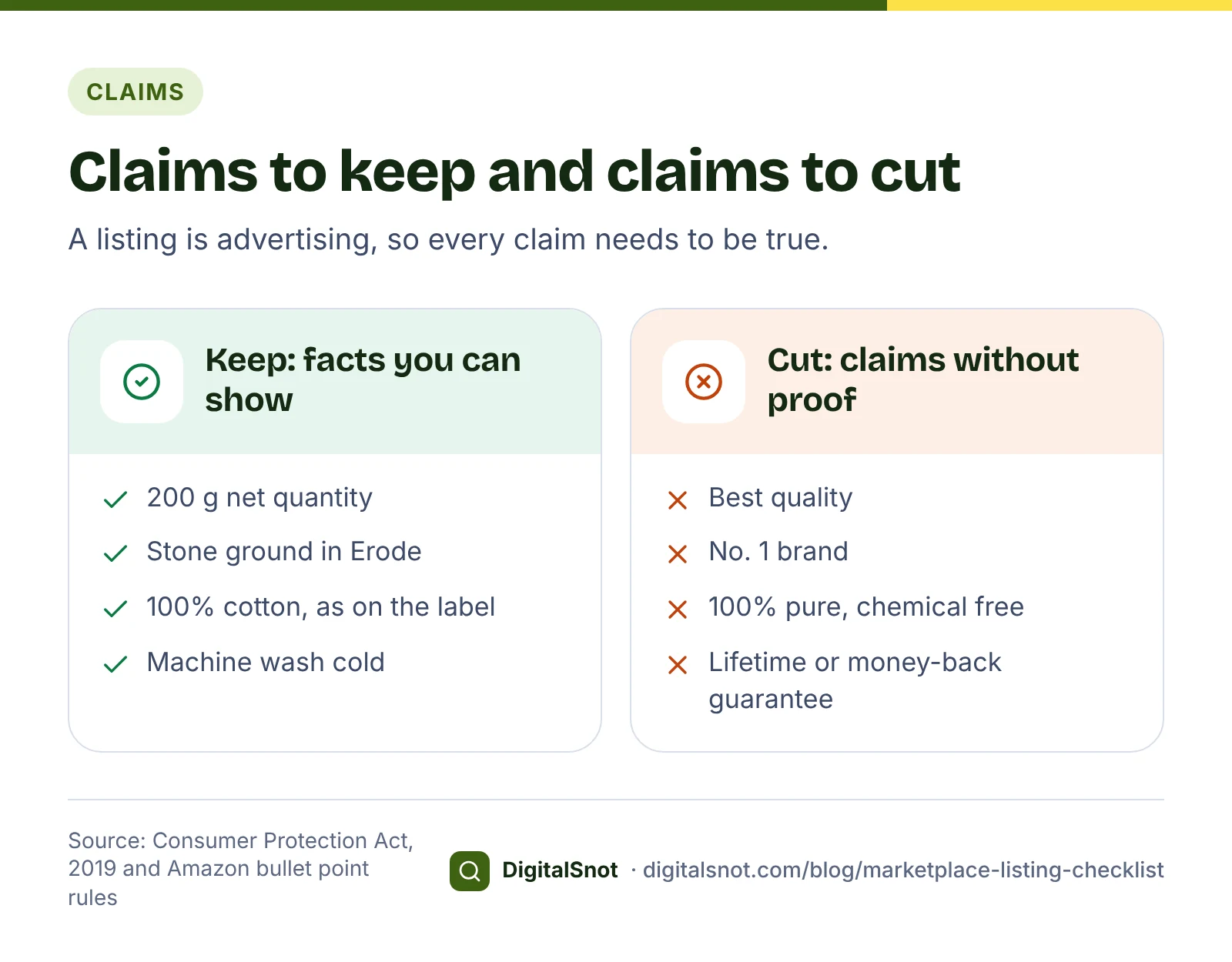
A listing is advertising. The Consumer Protection Act, 2019 covers publicity on the internet, and section 2(28) treats an advertisement that falsely describes a product, or gives a false guarantee, as misleading. The CCPA's 2022 guidelines on misleading advertisements also set conditions for calling anything free.
In practice, leave out claims you cannot back with a test report, a certificate or a clear fact: "100% pure", "chemical free", "No. 1 brand", "best quality" and "lifetime guarantee" are the usual ones. Say what the product is and what it does, plainly.
A worked example: one turmeric listing
Haldi Haat Spices in Erode is a made-up brand listing a 200 g pouch of turmeric powder on Amazon.in. Its first draft title had 90 characters: "HALDI HAAT Best Quality Turmeric Powder Haldi Powder Turmeric Powder 200gm!! Free Delivery". It is over 75 characters, uses "Powder" three times, and carries capitals, "!!", "Best Quality" and "Free Delivery".
The new title has 59 characters: "Haldi Haat Erode Turmeric Powder, Stone Ground, 200 g Pouch". The item highlights say where the turmeric comes from and what it suits. Each bullet gives one fact, and the detail fields carry the packer's name and address, the net quantity, the MRP inclusive of all taxes and the consumer care number and email. The search terms field holds other names buyers use, such as "manjal", the Tamil word for turmeric, which are not already in the title.
Your next step
Take your best-selling listing and run it through the Marketplace Listing Checker today, then check its declarations and photos. Fix the worst problems first, and use the same product sheet for every new listing. Our post on your real profit per order helps if you are repricing at the same time, all our free tools for online sellers are on one page, and if you want help with your listings, get in touch.
Free tools in this article
- Product Description Builder Turn your product details into titles, descriptions and bullet points, checked against Merchant Center Help.
- Marketplace Listing Checker (Amazon, Flipkart, Meesho) Check titles, bullets, search terms and product photos against Amazon.in, Flipkart and Meesho rules.
- Product Photo Checker Check product photos against Amazon.in, Flipkart, Meesho and Merchant Center image rules.
- Package Label Checker (Legal Metrology) Check a pack label and its listing for the declarations India's Legal Metrology rules ask for.
- Size Chart Builder Make a clear size chart in inches and cm, as an HTML table, CSV or image, with checks for gaps.
By the numbers
- characters, including spaces: the Amazon.in title limit in every category except media from 27 July 2026
- 75
- Source: Amazon Seller Central India announcement
- the date from which goods sold on e-commerce platforms must show the Legal Metrology declarations
- 1 Jan 2018
- Source: PIB: Department of Consumer Affairs
Frequently asked questions
How long can an Amazon.in product title be?
From 27 July 2026, titles in all categories except media must be 75 characters or less, including spaces. Item highlights add another 125 characters for details such as materials or uses. Amazon says titles still over 75 characters are changed gradually to its own suggestion, and brand owners get 14 days to review the change.
Which characters are not allowed in Amazon.in titles?
Since 21 January 2025, Amazon.in titles may not use ! $ ? _ { } ^ ¬ ¦ unless they are part of the brand name, and may not use the same word more than twice, apart from prepositions, articles and conjunctions.
Do Flipkart and Meesho have title length limits?
Neither publishes one on its public seller pages. Flipkart asks for a short title built on the main search terms, such as material, colour and size, and Meesho lists details such as fabric, fit, size and pattern. Check the limits for your category in Seller Hub or the Supplier Panel.
What details must a listing for packed goods show?
Since 1 January 2018, goods on e-commerce platforms must show the Legal Metrology declarations: the maker, packer or importer's name and address, the product name, net quantity, MRP inclusive of all taxes and consumer care details, plus the country of origin for imported goods. Type them into the listing fields, not only into photos.
How do I add keywords without stuffing?
Use each important word once, where it reads naturally: the product type in the title, materials and uses in the highlights and bullets, and other names or spellings in Amazon's search terms. Amazon's title rules bar a word used more than twice, and a stuffed title is harder for buyers to read.
Can I write "100% pure" or "money-back guarantee" in my listing?
Only if it is true and you can prove it. The Consumer Protection Act, 2019 treats an advertisement that falsely describes a product or gives a false guarantee as misleading, and Amazon's bullet point rules restrict refund guarantees. Say what the product is and what it does instead.
Sources
Every figure and claim in this article comes from the sources below. We checked each one when writing and link to the original so you can read it yourself. Credit belongs to the authors and publishers listed. How we write and check our articles.
-
1
Updates to improve your product titles begin on July 27
Amazon Seller Central India · 75-character titles from 27 July 2026 except media, 125 characters of item highlights, gradual changes to Amazon's suggestion and 14 days for brand owners.
-
2
New product title requirements effective from January 21, 2025
Amazon Seller Central India · No word more than twice except prepositions, articles and conjunctions; no ! $ ? _ { } ^ ¬ ¦ unless part of the brand name.
-
3
Review updated bullet point requirements to optimize your listings
Amazon Seller Central India · From 15 August 2024, bullet points restrict special characters, emojis and phrases such as refund guarantees.
-
4
Product listing optimisation guide
Flipkart Seller Hub · Short titles with the main search terms, keywords placed naturally, accurate specifications.
-
5
How to list products on Flipkart
Flipkart Seller Hub · Avoid vague titles; name colour, size and style.
-
6
Sell kurtis online
Meesho Supplier · Required details such as price, GST percentage, HSN code and weight; attributes such as fabric, fit, size and pattern; a short description.
-
7
Product data specification
Google Merchant Center Help · Titles up to 150 characters and descriptions up to 5,000.
-
8
Amendments to the Legal Metrology (Packaged Commodities) Rules, 2011 (2017)
PIB: Department of Consumer Affairs · Declarations on e-commerce platforms from 1 January 2018.
-
9
Notices to e-commerce companies over country of origin
PIB: Department of Consumer Affairs · Action over missing country of origin declarations online.
-
10
Consumer Protection (E-Commerce) Rules, 2020 (Gazette)
Department of Consumer Affairs · Sellers give the details buyers need before buying, including the country of origin.
-
11
Legal Metrology (Packaged Commodities) Rules, 2011 with all amendments
Department of Consumer Affairs · Rule 18(2): no sale of a pre-packed product above its retail sale price.
-
12
Legal Metrology (Packaged Commodities) (Third Amendment) Rules, 2022
Department of Consumer Affairs · Garments sold loose or open: sizes such as S, M or L with measurements in centimetres or metres.
-
13
Consumer Protection Act, 2019
India Code · Advertising includes publicity on the internet; section 2(28) defines a misleading advertisement.
-
14
Guidelines for Prevention of Misleading Advertisements, 2022 (CCPA notification)
Department of Consumer Affairs · Conditions for calling something free.