GST invoice format: what a tax invoice must show (with a free template)
The details Rule 46 asks for on a GST tax invoice, when to issue a bill of supply instead, HSN digits, invoice numbers, e-invoicing, and a free template to fill in.

On this page (10 sections)
- 1When you must issue a tax invoice
- 2What Rule 46 asks a tax invoice to show
- 3Tax invoice, bill of supply or proforma: which one
- 4B2B and B2C invoices: what changes
- 5HSN digits, invoice numbers and e-invoicing
- 6Worked example: Sharma Electricals, Indore
- 7Common invoice errors to catch before you send
- 8Make your invoice with the free template
- 9Your next step
- 10Sources
A GST invoice with a missing detail can cost your buyer their input tax credit and cost you a difficult conversation. This post walks through the GST invoice format: what a tax invoice must show, when to issue a bill of supply instead, how many HSN digits and characters you may use, and whether e-invoicing applies to you. At the end you can make your own invoice with our free template. This is general information, not tax advice: check rates, codes and your own case with your CA.
When you must issue a tax invoice
Under section 31 of the CGST Act, a registered business that makes a taxable supply issues a tax invoice. For goods, that is before or at the time the goods are removed or delivered. For services, Rule 47 gives you 30 days from the date of supply, or 45 days for insurers, banks, financial institutions and NBFCs.
Two practical rules sit alongside this. If a sale is under ₹200 and the buyer is not registered and does not ask for an invoice, you may issue one consolidated tax invoice at the end of the day for all such sales. And Rule 48 asks for goods invoices in three copies, marked original for recipient, duplicate for transporter and triplicate for supplier, and for service invoices in two.
What Rule 46 asks a tax invoice to show
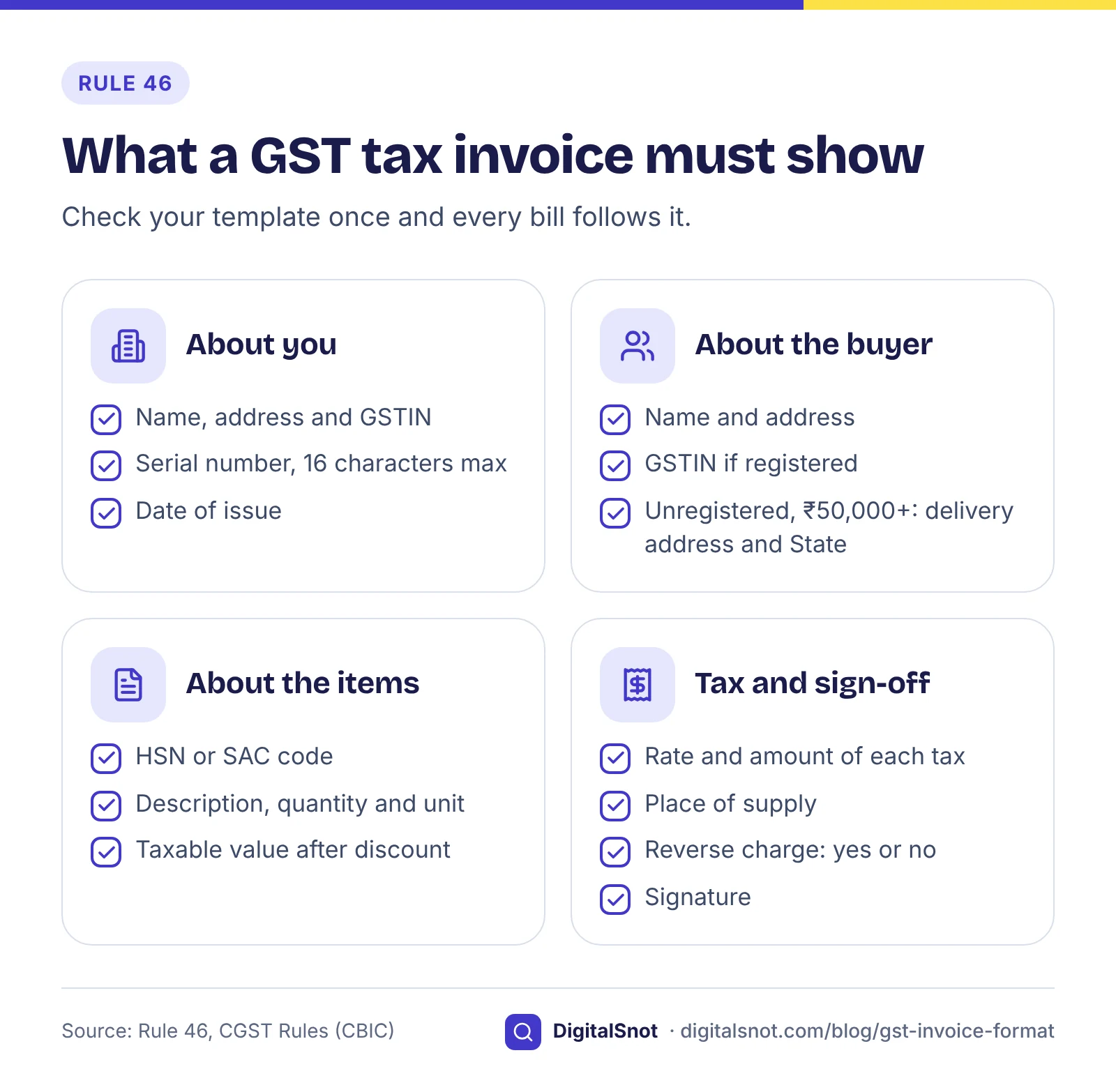
Rule 46 of the CGST Rules is the checklist. A tax invoice must show:
- Your name, address and GSTIN.
- A consecutive serial number of up to 16 characters, in one or more series, using letters, numbers, hyphens or dashes and slashes, unique for the financial year.
- The date of issue.
- The buyer's name, address and GSTIN, if the buyer is registered.
- For an unregistered buyer, when the taxable value is ₹50,000 or more: the name, address, delivery address, and the State's name and code.
- The HSN code for goods, or the accounting code (SAC) for services.
- A description, and the quantity and unit for goods.
- The total value and the taxable value after any discount.
- The rate and amount of each tax: CGST and SGST (or UTGST), or IGST, and any cess.
- The place of supply, with the State's name for a supply between States, and the delivery address if it differs.
- Whether tax is payable on reverse charge.
- Your signature or digital signature, or that of an authorised representative.
Tax invoice, bill of supply or proforma: which one
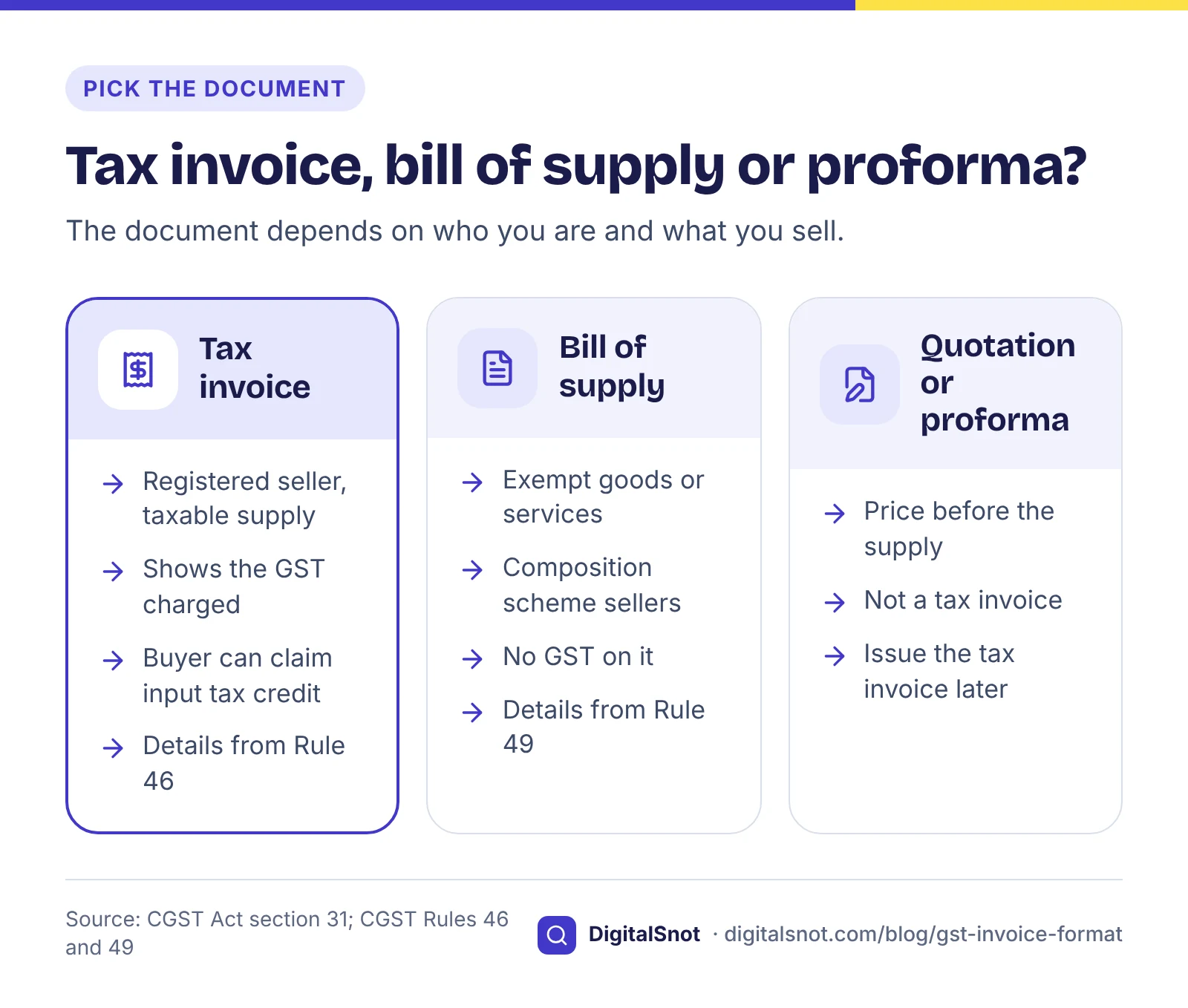
Not every sale gets a tax invoice. The type of document depends on who you are and what you sell.
- Tax invoice: a registered business making a taxable supply. It shows the GST charged, and a registered buyer uses it to claim input tax credit.
- Bill of supply: a registered business supplying exempt goods or services, or paying tax under the composition scheme, issues this instead, with no GST on it (section 31(3)(c), with the details in Rule 49). A composition seller must print "composition taxable person, not eligible to collect tax on supplies" at the top, under Rule 5.
- Quotation or proforma invoice: tells the buyer what they will pay before the supply. It is not a tax invoice, so issue the tax invoice when you supply.
B2B and B2C invoices: what changes
When you sell to a registered business (B2B), the buyer's GSTIN is the detail that matters most. Under section 16(2) of the CGST Act, the buyer can claim input tax credit only when it holds your tax invoice and you have reported that invoice in your GSTR-1, so it reaches them. A typing error in their GSTIN can hold up their credit, and your payment with it.
When you sell to a consumer (B2C), there is no GSTIN to show. The delivery address and State come into play once the taxable value reaches ₹50,000, and the end-of-day consolidated invoice is allowed for sales under ₹200.
In both cases the tax type follows the States. When you and the place of supply are in the same State, charge CGST plus SGST at equal rates, half each. When they are in different States, charge IGST at the full rate. Since 22 September 2025, after the 56th GST Council meeting, the main rates are 5% and 18%, with 40% for a short list of goods such as pan masala, tobacco and aerated drinks. To split a price or take GST out of one, use our GST Calculator.
HSN digits, invoice numbers and e-invoicing
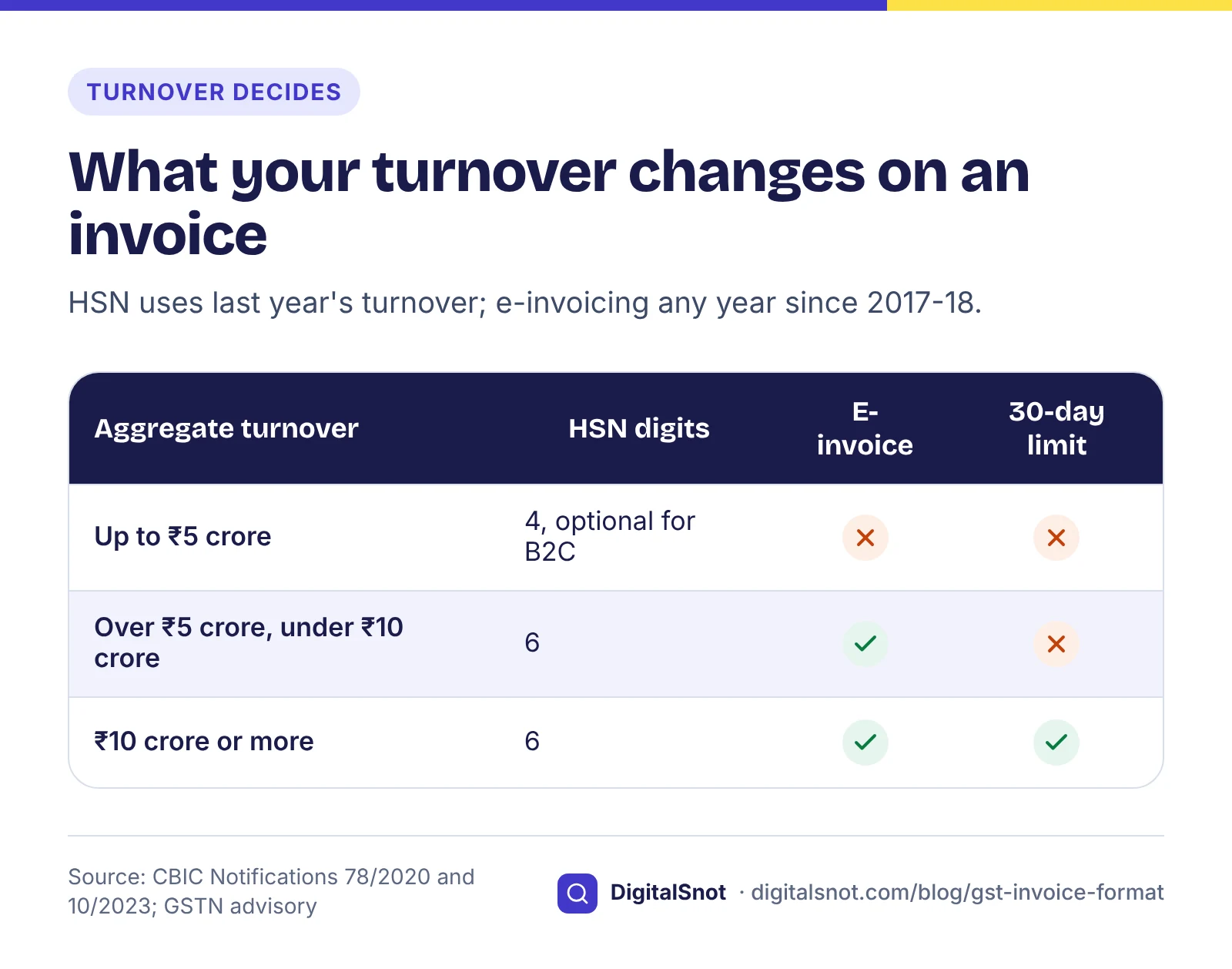
HSN digits. Under Notification 78/2020-Central Tax, from 1 April 2021, a business with aggregate turnover of up to ₹5 crore in the previous financial year shows 4 digits of the HSN code, and may leave it off invoices to unregistered buyers. Above ₹5 crore, every tax invoice shows 6 digits.
Invoice numbers. "SE/26-27/0148" has 13 characters and fits. "SHARMAELEC/2026-27/000148" has 25 and does not. Spaces, hashes and underscores are not in the allowed list. If two counters or branches bill at once, give each its own series, such as A/26-27/001 and B/26-27/001, so no number repeats in the year.
E-invoicing. Since 1 August 2023, under Notification 10/2023-Central Tax, a business whose aggregate turnover exceeded ₹5 crore in any financial year from 2017-18 must report its invoices to registered buyers, and its exports, to the Invoice Registration Portal and print the IRN and QR code it gets back. Some sectors are exempt. Rule 48 says an invoice that such a business issues any other way is not treated as an invoice. Since 1 April 2025, a GSTN advisory also stops businesses with turnover of ₹10 crore or more from reporting an invoice more than 30 days after its date.
Worked example: Sharma Electricals, Indore
Sharma Electricals is a made-up shop registered in Madhya Pradesh, with ₹3 crore of turnover last year. It is below ₹5 crore, so it shows 4 HSN digits and does not issue e-invoices. Here are three sales of fittings taxed at 18% in this example.
| Sale | Taxable value | Tax | What the invoice adds |
|---|---|---|---|
| Registered contractor in Bhopal | ₹40,000 | CGST ₹3,600 + SGST ₹3,600 | Buyer's GSTIN; total ₹47,200 |
| Registered dealer in Ahmedabad | ₹40,000 | IGST ₹7,200 | Buyer's GSTIN; place of supply: Gujarat |
| Unregistered homeowner in Indore | ₹62,000 | CGST ₹5,580 + SGST ₹5,580 | Delivery address; State: Madhya Pradesh, code 23 |
The third sale is to a consumer, so the 4-digit HSN code may be left off, though showing it does no harm. Every invoice carries the reverse charge line ("No" here), the signature and a number from the shop's series, such as SE/26-27/0148.
Common invoice errors to catch before you send
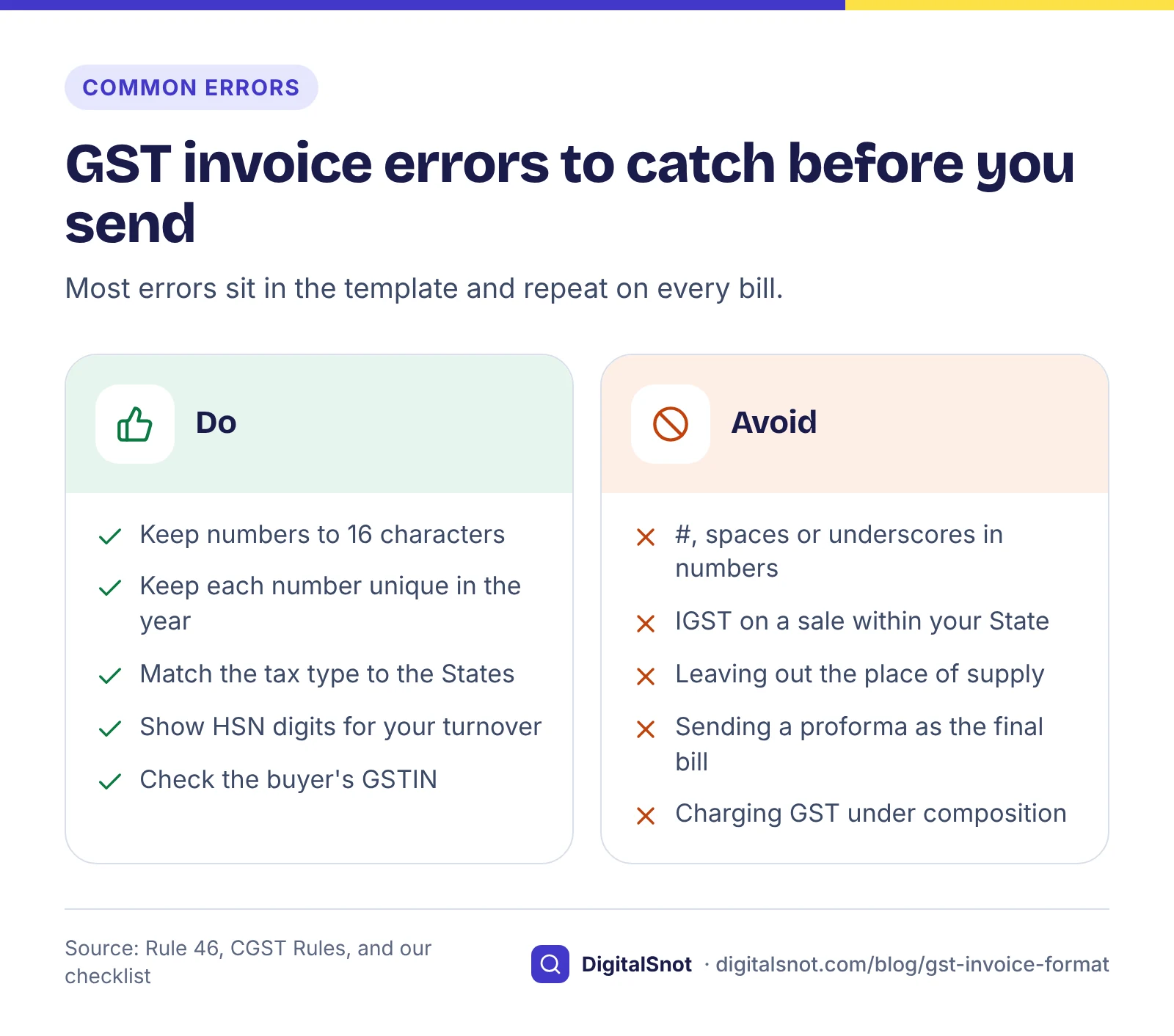
Most invoice problems are small and repeated on every bill, because they live in the template. Look for these:
- Numbers that break the rule: more than 16 characters, symbols such as # or spaces, or the same number used by two counters.
- The wrong tax type: IGST on a sale within your State, or CGST and SGST on a sale to another State.
- No place of supply on a sale between States.
- Too few HSN digits for your turnover, or a code typed from memory.
- No reverse charge line, even when the answer is "No".
- Tax or totals that do not add up after a discount or rounding.
- A proforma sent as the final bill, or GST charged by a composition seller.
To check an invoice you have already made, type its details into our GST Invoice Checker. It lists the Rule 46 details that are missing, tests the invoice number and the GSTIN format, checks the HSN digits your turnover needs, says whether the sale needs CGST and SGST or IGST from the two States, and checks that the tax and total add up (within ₹1, our check). It checks the GSTIN's format only, not whether it is registered, and it does not cover e-invoicing, bills of supply or credit notes.
Make your invoice with the free template
Our GST Invoice and Quotation Generator makes a tax invoice, bill of supply, quotation or proforma invoice on A4:
- Fill in your business once: name, address, GSTIN, State, bank details and logo. They stay in your browser for next time.
- Add the buyer, the place of supply if it differs from the buyer's State, and each item with its HSN or SAC code, quantity, rate, discount and GST rate. The tool works out CGST and SGST or IGST, takes discounts off before GST and writes the total in words in lakh and crore.
- Fix what its Rule 46 checks flag, then print or save a PDF and move to the next number.
It does not do e-invoicing, so a business above ₹5 crore must still generate the IRN through the portal. For an advance, a registered business issues a receipt voucher under section 31(3)(d); our Payment Receipt Maker makes a plain payment receipt, not a receipt voucher.
Your next step
Open your last three invoices and check them against the list above, or run one through the GST Invoice Checker. Fix the template once, and every new bill starts from the right layout. If you send invoices by email and customers say they never arrive, read why business emails land in spam. More free tools for GST and small business paperwork are on our free tools page.
Free tools in this article
- GST Calculator Add GST to a price or take it out, split into CGST and SGST or IGST, for one item or a whole bill.
- GST Invoice Checker Check an invoice for missing Rule 46 fields, the invoice number, GSTIN, tax split and totals.
- GST Invoice and Quotation Generator Make a GST tax invoice, bill of supply or quotation, check it against Rule 46, and print it or save a PDF.
- Payment Receipt Maker Make a receipt for a full payment, part payment or advance, with the balance left, and print it on A4 or A5.
Frequently asked questions
What must a GST tax invoice contain?
Rule 46 of the CGST Rules lists your name, address and GSTIN, a serial number, the date, the buyer's details and GSTIN if registered, the HSN or SAC code, a description, the taxable value, the rate and amount of each tax, the place of supply, whether reverse charge applies, and a signature.
How long can a GST invoice number be?
Up to 16 characters, using letters, numbers, hyphens or dashes and slashes, in one or more series, and unique for the financial year. A number such as SE/26-27/0148 fits; spaces, hashes and underscores are not allowed.
Is a bill of supply the same as a tax invoice?
No. A bill of supply is issued for exempt supplies or by a composition seller, and it carries no GST. A tax invoice is issued for taxable supplies and shows the GST charged, which a registered buyer can claim as input tax credit.
How many HSN digits must my invoice show?
Under Notification 78/2020-Central Tax, 4 digits if your aggregate turnover in the previous financial year was up to ₹5 crore, and you may leave the code off invoices to unregistered buyers. Above ₹5 crore, 6 digits on every tax invoice.
When do I have to issue e-invoices?
Since 1 August 2023, if your aggregate turnover exceeded ₹5 crore in any financial year from 2017-18, invoices to registered buyers and exports must be reported to the Invoice Registration Portal, with the IRN and QR code printed. Some sectors are exempt, so ask your CA.
Can I issue a GST invoice without the buyer's GSTIN?
Yes, when the buyer is not registered. If the taxable value is ₹50,000 or more, add the buyer's name, address, delivery address and the State's name and code. A registered buyer needs its GSTIN on the invoice to claim input tax credit.
Sources
Every figure and claim in this article comes from the sources below. We checked each one when writing and link to the original so you can read it yourself. Credit belongs to the authors and publishers listed. How we write and check our articles.
-
1
Rule 46: Tax invoice
CBIC (CGST Rules, 2017) · Details a tax invoice must show, the 16-character serial number, the ₹50,000 rule for unregistered buyers and the ₹200 consolidated invoice
-
2
Section 31: Tax invoice
CBIC (CGST Act, 2017) · When a tax invoice is issued, the bill of supply and receipt vouchers
-
3
Rule 47: Time limit for issuing tax invoice
CBIC (CGST Rules, 2017) · 30 days for services, 45 days for insurers, banks, financial institutions and NBFCs
-
4
Rule 48: Manner of issuing invoice
CBIC (CGST Rules, 2017) · Three copies for goods, two for services, and invoices of e-invoicing businesses
-
5
Rule 49: Bill of supply
CBIC (CGST Rules, 2017) · Details of a bill of supply
-
6
Rule 5: Conditions for composition
CBIC (CGST Rules, 2017) · Composition sellers print "composition taxable person, not eligible to collect tax on supplies"
-
7
Central Goods and Services Tax Act, 2017 (compilation)
CBIC · Section 16(2): input tax credit needs the tax invoice and the supplier's reported details
-
8
Notification 78/2020-Central Tax
GST Council · 4 or 6 HSN digits by turnover from 1 April 2021
-
9
Notification 10/2023-Central Tax
GST Council · E-invoicing for aggregate turnover above ₹5 crore from 1 August 2023
-
10
Time limit for reporting e-invoices on the IRP portal (GSTN advisory)
Maharashtra GST Department · 30-day reporting limit for turnover of ₹10 crore or more from 1 April 2025
-
11
Recommendations of the 56th meeting of the GST Council
Press Information Bureau · Main GST rates of 5% and 18%, with a 40% rate for a short list of goods