Guide · Local SEO
Local citations in 2026: which listings still matter
Which business listings still matter in 2026, from Google, Apple Business and Bing Places to Justdial and IndiaMART, how to fix wrong details, and when to stop adding more.

On this page (10 sections)
- 1What local citations do in 2026: rankings, trust and AI answers
- 2How to prioritise listings: a scoring method you can repeat
- 3Tier 1: Google Business Profile, Apple Business and Bing Places
- 4Tier 2: industry sites, review platforms and data aggregators
- 5India: Justdial, IndiaMART, Sulekha and sector sites
- 6Find and fix inconsistent listings
- 7Duplicates, closures, moves and rebrands: what to do
- 8How many citations is enough?
- 9A yearly listings maintenance routine
- 10Sources
Local citations are mentions of your business name, address and phone number on other websites: map apps, directories, review sites, industry portals and local press. The old advice was to build hundreds of them. That advice is out of date, but citations still matter in 2026. Their job has changed: they confirm your facts to Google, Apple and Microsoft, and AI assistants read them when someone asks for a business recommendation.
The evidence points both ways. Whitespark's 2026 Local Search Ranking Factors survey found citations losing weight in Google's local pack again, yet three of its top five factors for AI search visibility were citation factors. Yext's analysis of 6.8 million AI citations found listings made up 42% of them. The useful question is not "how many directories?" but "which ones, and are they right?"
Who this is for: owners and in-house marketers of local businesses in the UK, the US and India. What you will be able to do: choose which listings to claim first for your type of business, audit and fix inconsistent details, handle duplicates, moves and closures, judge when you have enough citations, and keep them current with a yearly routine. Where we found no evidence, for example on how AI tools use Indian directories, we say so.
What local citations do in 2026: rankings, trust and AI answers
A local citation is any online mention of your business's name, address and phone number (NAP), with or without a link. In 2026 citations do three jobs: they feed and confirm the data behind map listings, they put you in front of customers on the sites they already use, and they supply facts to AI answers.
Structured and unstructured citations
Structured citations are listings on platforms built for business data, such as Google Business Profile, Apple Maps, Bing Places, Yelp or Justdial, where your details sit in set fields. Unstructured citations are mentions inside other content: a local news story, a "best of" list or a trade association's member page. You fill in structured citations yourself; unstructured ones have to be earned.
Job 1: confirming your facts to Google
Google builds Business Profiles from more than what you type in. Its help page on how Google sources and uses information in Business Profiles lists crawled web content, licensed data from third parties, facts contributed by users, and Google's own interactions with a place. A wrong phone number on a directory is one of those inputs, and it can contradict what you entered.
As a ranking factor for the local pack, citations matter less than they used to. In Whitespark's 2026 report, where 47 local search experts scored 187 factors, citation signals dropped in value again for local pack rankings, continuing a downward trend. Treat core citations as hygiene: missing or wrong ones can hurt, but piling up more rarely helps.
Job 2: being found where customers already look
Directories still fill a large share of ordinary search results. In BrightLocal's Business Listings Visibility Study (October 2024, about 8,000 Google results for local-intent searches), business directories made up 31% of the top ten organic results. Yelp accounted for 28% of those directory results, Tripadvisor 10% and Expertise 8%. The share varied with wording and sector: directories made up 37% of results for informational local searches, and 72% for "fast food restaurants" searches, the highest of any industry tested.
Job 3: supplying facts to AI answers
AI assistants read listings when they answer local questions. Yext's research, published in October 2025, analysed 6.8 million citations from ChatGPT, Gemini and Perplexity for location-based queries run between 1 July and 31 August 2025. Brand websites made up 44% of citations, listings 42% and forums such as Reddit 2%. OpenAI's model drew 48.7% of its citations from listings, and in healthcare listings reached 52.6%. Yext sells listings management, so treat this as vendor research, though it agrees with the studies below.
BrightLocal's analysis of where local AI citations come from found Google Business Profile made up 28.5% of citations and Yelp 8.53%, with Yelp used more by ChatGPT. Specialist sites also appear by sector. In a smaller BrightLocal test of 20 searches across ten industries, ChatGPT drew on ten different dental directories for dentistry searches.
One expert contributing to Whitespark's report added that curated "best of" lists on heavily referenced sites, local magazines and blogs, and forums such as Reddit are disproportionately cited by AI tools. These are expert opinions, not measurements, but they agree with the studies: relevance and accuracy beat volume.
How to prioritise listings: a scoring method you can repeat
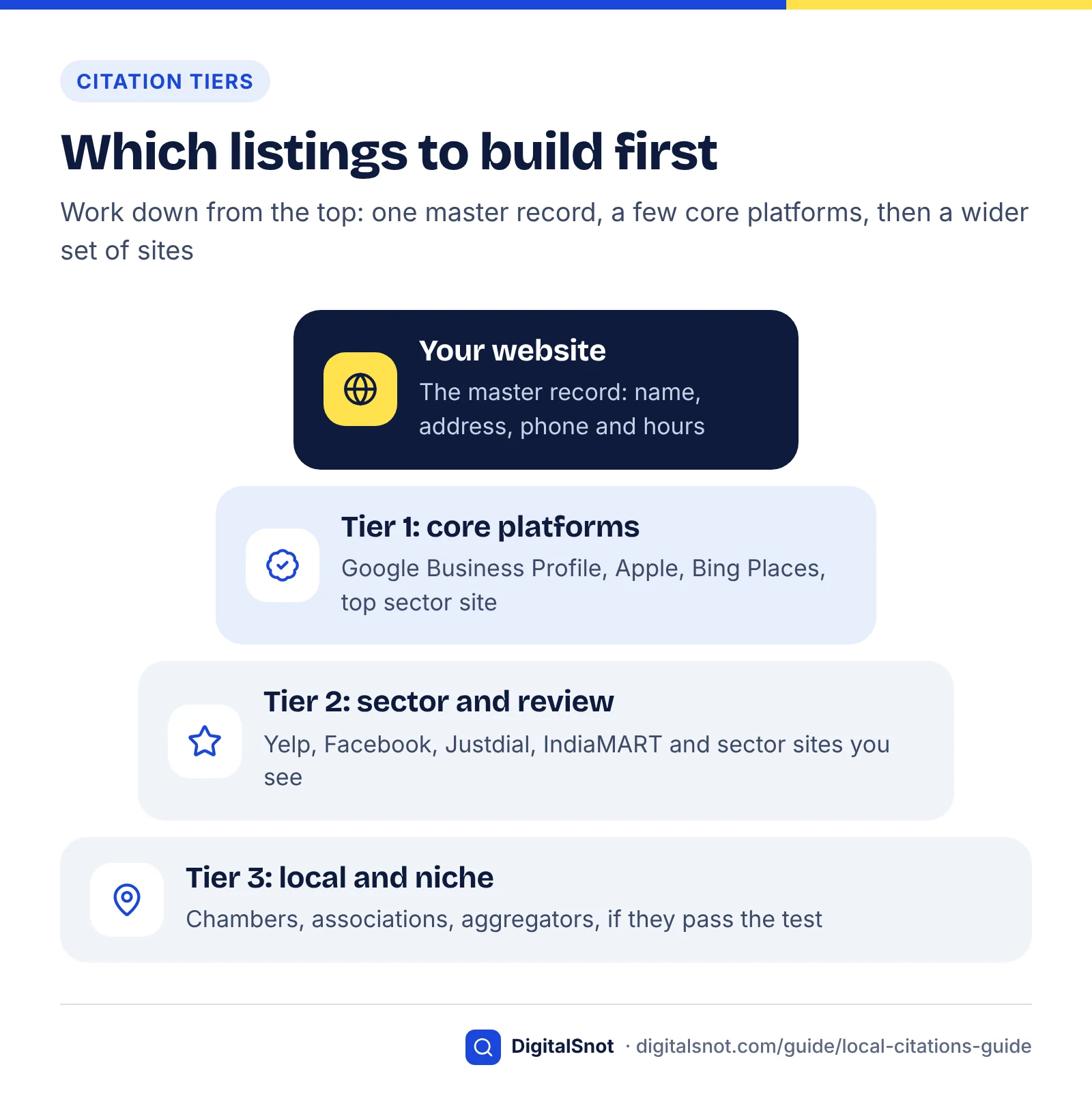
Prioritise each listing by three questions: is there evidence it feeds search results or AI answers, do your customers use it to choose a business, and does its data flow into other products? Score each from 0 to 2, add them up, then weigh the total against the effort.
Method: we scored common platforms in October 2026 using only the evidence cited in this guide. "Evidence" is 2 for platform documentation or a large citation study, 1 for indirect evidence, 0 for none found. "Customer use" is our judgement for a typical small business. "Data reach" is 2 when the listing feeds a major map, search engine or assistant, 1 when its public pages can be crawled and quoted, 0 otherwise. A total of 5–6 is Tier 1, 3–4 Tier 2, 1–2 Tier 3 and 0 means skip. Re-score for your market with the search test below.
| Platform | Evidence | Customer use | Data reach | Score (of 6) | Effort | Tier |
|---|---|---|---|---|---|---|
| Google Business Profile | 2 | 2 | 2 | 6 | Medium (verification) | 1 |
| Bing Places for Business | 2 | 1 | 2 | 5 | Low (import from Google) | 1 |
| Apple Business (Apple Maps) | 1 | 1–2 | 2 | 4–5 | Low to medium | 1–2 |
| Leading directory in your sector | 2 | 2 | 1 | 5 | Medium (vetting, profile) | 1 |
| Yelp (US; weaker in UK) | 2 | 1–2 | 1 | 4–5 | Low | 2 (1 in the US) |
| Facebook page | 1 | 1–2 | 1 | 3–4 | Low | 2 |
| Justdial (India) | 0 | 2 | 1 | 3 | Low | 2, test for 1 |
| IndiaMART (India, B2B) | 0 | 2 for suppliers | 1 | 3 | Medium | 2, test for 1 |
| Other sector and local sites | 1 | 1 | 0–1 | 2–3 | Low to medium | 2–3 |
| Bulk "submit your business" directories | 0 | 0 | 0–1 | 0–1 | Low, but wasted | Skip |
Two results stand out. The leading directory in your sector scores as high as Bing Places, because AI models lean on sector sites in niches such as dentistry and healthcare, so treat your top one or two sector sites as Tier 1. And Justdial and IndiaMART score low on evidence only because no published study measures them, not because they fail. Indian businesses should run the test below and move them up if they appear. Apple Business lands in Tier 1 or 2 depending on how many of your customers use Apple Maps; it takes little effort, so claim it alongside Google and Bing.
The 20-minute search test
- In a private browser window, search Google for "[service] [town]" and "best [service] [town]". Note every directory in the top ten.
- Ask Google AI Mode and one or two assistants, such as ChatGPT or Perplexity, the same question. Note the sources they cite.
- Give any directory that appears in two or more of those places an evidence score of 2.
- Re-add the scores and sort the list. That is your citation plan.
AI answers change between runs. BrightLocal's September 2026 study of about 200,000 local AI prompts found only 20–33% average overlap between repeat result sets, so run each AI question at least three times. Our guide to local SEO for AI search explains how to track mention rates.
Tier 1: Google Business Profile, Apple Business and Bing Places
Claim and complete these three before anything else. They hold the business data behind the maps built into Google, Apple and Microsoft products, and Google and Microsoft both connect their listing to AI answers.
Google Business Profile
Your Business Profile is the most important citation you have, and it sets the master version of your details that every other listing should copy. In BrightLocal's September 2026 study, Google Maps named a tracked business in 66% of searches, against 32–38% for ChatGPT, AI Mode and AI Overviews, and Business Profile was heavily used as a source by AI Mode and AI Overviews. Our Google Business Profile optimisation guide covers every field, and restaurants can start with our Business Profile tips for restaurants.
Apple Business (formerly Apple Business Connect)
Apple Business is Apple's free platform for businesses, and it is now where you manage your Apple Maps place card. Apple announced it in March 2026 and launched it on 14 April 2026, free in the US and more than 200 countries and regions, replacing Apple Business Connect, Business Essentials and Business Manager.
Apple said existing Business Connect data, including claimed locations, place card information and photos, would migrate automatically. If you claimed your Apple Maps listing before April 2026, sign in to Apple Business and check everything came across; if you never claimed it, do so now. Apple also said ads on Apple Maps would reach businesses in the US and Canada from summer 2026, which makes an accurate free listing more important, not less (checked October 2026). Guides that still say "set up Apple Business Connect" are out of date.
Bing Places for Business
Bing Places for Business is Microsoft's listing service for local businesses. When Microsoft introduced its AI Performance report in Bing Webmaster Tools in February 2026, it said registering with Bing Places for Business helps keep your address, hours and contact details current and eligible for inclusion in AI-generated responses.
The fastest route is importing from Google. Bing's help page on syncing a Google Business Profile says verified Google listings are verified automatically and usually publish in 7–12 days. The catches: syncing can create a duplicate if you are already on Bing, Bing uses its own categories so check them after importing, and synced listings are edited in Google and then re-synced (checked October 2026).
Do directory listings still matter in 2026?
| Platform | Where the data shows | Documented AI link | Watch out for |
|---|---|---|---|
| Google Business Profile | Search, Maps, AI Overviews, AI Mode | Yes: heavily used by Google's AI surfaces (BrightLocal) | Keyword-stuffed names risk suspension |
| Apple Business | Apple Maps place cards | No AI-citation data found | Check migrated Business Connect details |
| Bing Places for Business | Bing search and Microsoft AI answers | Yes: Microsoft links it to AI responses | Duplicates on import; check categories |
Tier 2: industry sites, review platforms and data aggregators
After Tier 1, add the sites that rank or get cited for your type of business in your country. For most single-location businesses that is five to fifteen platforms chosen with the search test, not a bulk list of a hundred.
Sector sites by business type
These are examples to test, not endorsements. Keep the ones that appear in your own searches and AI answers, and add any trade body or association directory that lists members in your field.
| Business type | UK examples | US examples | India examples |
|---|---|---|---|
| Trades and home services | Checkatrade, TrustATrader, MyBuilder, Rated People | Angi, Thumbtack, Better Business Bureau | Justdial, Sulekha, Urban Company |
| Clinics and dentists | NHS website (NHS services), Doctify | Healthgrades, Zocdoc | Practo, Justdial |
| Restaurants and cafés | Tripadvisor, OpenTable, delivery apps | Yelp, Tripadvisor, OpenTable, DoorDash, Uber Eats | Zomato, Swiggy |
| Salons and beauty | Treatwell, Fresha, Booksy | Booksy, Yelp | Justdial, Urban Company (at-home services) |
| Solicitors, lawyers and accountants | Law Society Find a Solicitor, ICAEW directory | Avvo, Justia | Justdial, Sulekha |
| B2B suppliers and manufacturers | Trade association member lists | Thomasnet | IndiaMART, TradeIndia |
Clinics have extra reason to get this right: in Yext's data, listings made up 52.6% of AI citations in healthcare, above the 42% average. Our post on local SEO for clinics covers the clinic-specific steps.
Review platforms
Review sites are citations with a second job: they carry your details and your reviews. In BrightLocal's citation analysis, Yelp made up 8.53% of local AI citations, with more use by ChatGPT. Claim the review platforms your customers use and reply to reviews there. Our guide to getting more Google reviews covers wording and timing that work on other platforms too.
Data aggregators
Data aggregators are companies that collect business records and distribute them to directories, apps and navigation systems, mostly in North America. Submitting to them can stop wrong data spreading, which helps multi-location US businesses. We found no recent independent study showing that aggregator submissions improve rankings or AI visibility on their own, so treat them as Tier 3. In the UK or India, check an aggregator covers your country before you pay.
What to skip
- Bulk packages promising 100 or more directory submissions. Most of those sites have no visitors and no evidence of use by search engines or AI tools.
- Directories outside your country or sector, unless they appear in your search test.
- Listings you cannot keep up to date. A forgotten profile with old hours is worse than none. If you use a paid listings tool, ask what happens to your listings if you cancel.
India: Justdial, IndiaMART, Sulekha and sector sites
In India, start with Google Business Profile, then add Justdial if you serve consumers, IndiaMART if you sell to businesses, and the leading platform in your category, such as Practo for doctors or Zomato and Swiggy for restaurants. Apple Business and Bing Places take little time, so claim them too.
Justdial
Justdial is a general local directory and search service. Its company overview reports about 56.1 million listings and 192.9 million quarterly unique users across web, mobile, app and voice as of 30 June 2026, and says owners can list their business for free. Justdial's investor pages show different headline figures, so treat these numbers as indicative (checked October 2026). Search Justdial for your business name and phone number, and claim and correct any listing you find before creating a new one.
IndiaMART
IndiaMART is a B2B marketplace where manufacturers, wholesalers and suppliers keep storefronts that buyers search and send enquiries to. Its results for the quarter to 31 March 2026 reported about 8.7 million supplier storefronts, about 220,000 of them paying suppliers. For a supplier, the storefront is often the most detailed citation you have, so make its company name, address and contact numbers match your website and Business Profile exactly.
Sulekha and sector platforms
Sulekha connects customers with local service experts, from chartered accountants to event organisers. Category platforms matter at least as much: Practo for doctors, Zomato and Swiggy for restaurants, Urban Company for home and beauty services. Pick the one or two where your customers actually book.
What we do not know about Indian listings and AI
We found no published study that measures how often ChatGPT, Gemini, AI Mode or Perplexity cite Justdial, IndiaMART or Sulekha (checked October 2026). Several agency blogs claim these sites drive AI recommendations, but none show data, so do not pay for "AI listing" upgrades on the strength of those claims. Run the search test in English and in the languages your customers use, and record which Indian sites the AI answers cite.
India-specific consistency traps
- Phone numbers: pick one primary number and one format, such as +91 and the ten-digit mobile number, and use it everywhere.
- Addresses with landmarks: "Near City Hospital" helps customers but creates variants. Keep the same building, street, area and PIN code order on every listing.
- Names in two scripts: keep the English name identical everywhere, and use any Hindi or regional-script version consistently.
Example (hypothetical): a packaging manufacturer in Ahmedabad finds its IndiaMART storefront shows an old factory address, its Justdial listing a former sales manager's mobile, and its Business Profile a shortened brand name. It writes one master record, fixes Business Profile first, then IndiaMART and Justdial, and puts the same details in its website footer.
Find and fix inconsistent listings
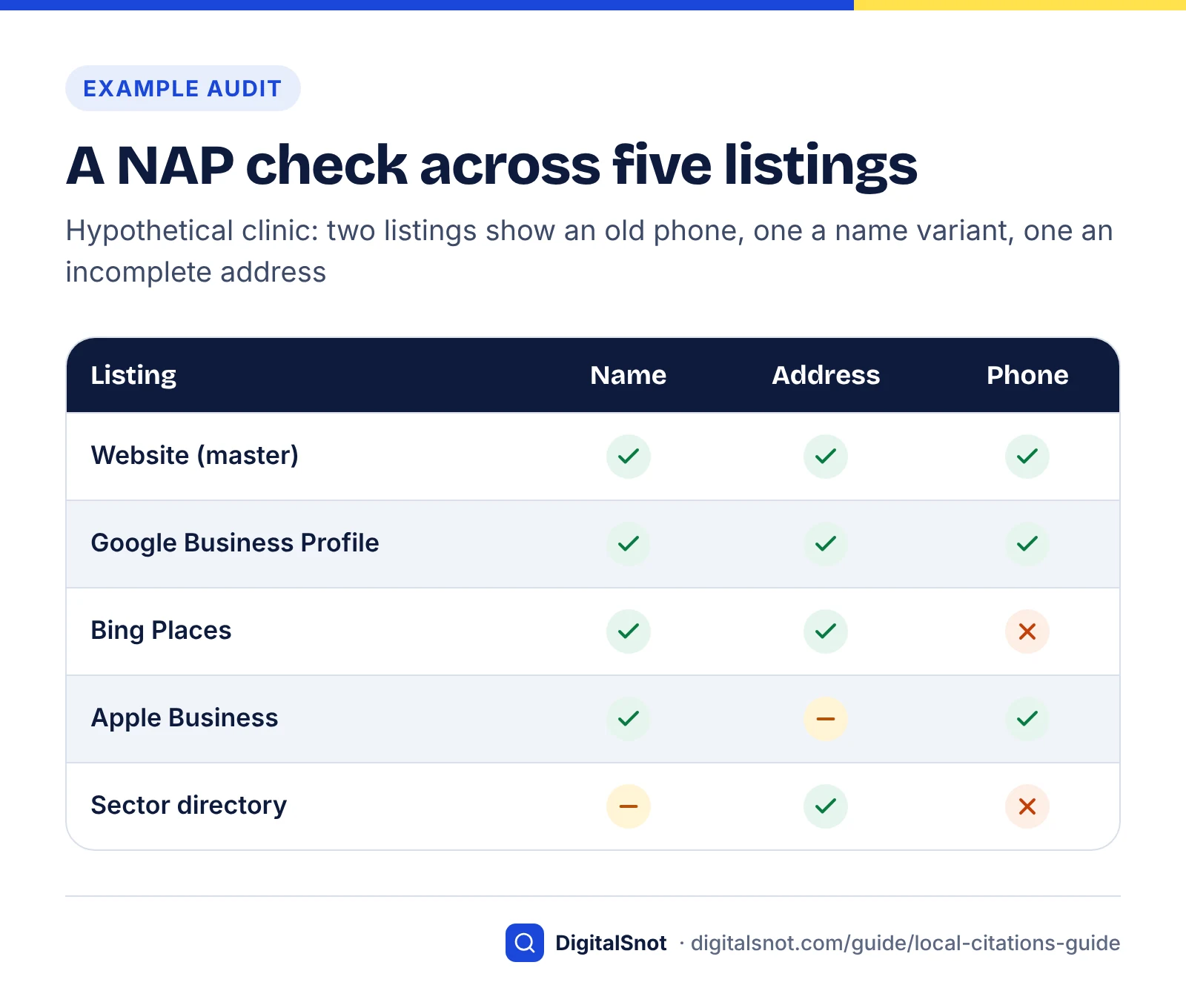
To clean up citations, write one master record of your business details, find every listing that disagrees with it, and fix them in tier order, starting with the sources other platforms copy. Most businesses can finish a first pass in an afternoon.
Step 1: write your master record
Decide the exact version of each fact before you touch a listing. Google's guidelines for representing your business say your name should reflect your real-world name, as used on your storefront, website and stationery. Taglines, store codes, hours, phone numbers and URLs are not allowed in the name, and adding unnecessary information can lead to suspension.
- Name: exactly as on your signage, with no keywords added.
- Address: one format, with unit number and postcode or PIN code.
- Phone: one primary local number, not a tracking number.
- Website: your homepage, or the matching location page for multi-site businesses.
- Hours, categories and a two-sentence description you can paste anywhere.
Step 2: see where Google got its data
Google's help page on editing your Business Profile says the Collected info section, under Edit profile, lists information Google has gathered, with its source and the date it was collected. Deleting an entry removes it from Google's records without changing other details on your profile. The section is only available in some regions, languages and business categories so far (checked October 2026). Where you have it, it can show which site supplied an old phone number.
Step 3: find every listing
- Search your current phone number in quotation marks, then every old number.
- Search your business name with each old address, and with your town.
- Check each Tier 1 and Tier 2 platform from your scoring list directly.
- Run your website and main listing URLs through our free AI Answer Consistency Checker. It flags conflicting brand facts, such as two phone numbers or addresses, across your pages and listings. Fix each conflict at its source, starting with phone numbers and hours.
Step 4: log it in an audit sheet
Use one row per listing so you can track progress and repeat the audit next year.
| Column | What to record | Example entry |
|---|---|---|
| Platform and tier | Name of the site and your tier score | Bing Places, Tier 1 |
| Listing URL | The exact page | Link to the listing |
| Claimed? | Yes, no, or claim pending | Pending, imported from Google |
| NAP, website, hours, category | Match or mismatch for each | Phone mismatch: old number |
| Duplicate? | Any second listing found | Yes, old address |
| Action, date, recheck | What you changed, when, and when to confirm | Fixed in Google, re-synced; recheck in four weeks |
Step 5: fix in tier order, then match your website
Fix Google Business Profile first, then Apple Business and Bing Places, then sector sites, then the rest. Edits can take days or weeks to appear, so recheck each on the date in your sheet. Then make your website match: put the master record in the footer and on the contact page, and add LocalBusiness structured data with the same details. Our free Schema Markup Generator builds LocalBusiness JSON-LD, and our schema markup guide explains which types still matter in 2026.
The free Brand Knowledge Graph Builder maps your brand as an entity (services, places, people and profiles) and outputs Organization schema with sameAs links to your official profiles. Structured data describes your business consistently; it is not a ranking shortcut and will not override a wrong listing elsewhere.
Duplicates, closures, moves and rebrands: what to do
Most listing problems come from change: a move, a new number, a closure or a new name. Update existing listings rather than creating new ones, and fix Google first.
Google's help page on resolving duplicate profiles says that if a business relocates, you should update the existing Business Profile, not create a new one. A duplicate created by mistake can be removed without affecting your verified profile, but removal deletes its content and linked managers, so check you are removing the right one. Google's page on marking your business as closed covers temporary and permanent closures, set from the Hours section of Edit profile; use special hours for short breaks such as holidays. A permanently closed profile may still appear in searches, labelled as closed.
| If this happens | Do this | Avoid this |
|---|---|---|
| You moved premises | Edit the address on your existing Google profile, then update Tier 1, sector sites and your website within a week | Creating a new profile at the new address |
| You found two Google profiles and manage both | Remove the one you created by mistake after checking which holds your reviews | Deleting the verified profile with your reviews |
| A duplicate you do not control | Follow Google's duplicate and ownership help to request access or report it | Making a third profile to "replace" both |
| You closed one location | Mark it permanently closed on Google, then close or update its other listings | Leaving it open, or pointing it at another branch |
| You changed your phone number | Update Tier 1 the same day, then all other listings; keep the old number forwarding for a few months | Changing only your website |
| You rebranded | Change the name on Google first (it may ask you to verify again), then every listing and your signage | Running old and new names side by side |
| A duplicate appeared on Bing after importing | Claim the existing Bing listing, keep one and remove the other | Editing both separately |
| Wrong details on a site you cannot claim | Use its "suggest an edit" or contact form; ignore it if it has no visitors | Paying a removal fee to an unknown directory |
If you already created a new Google profile after a move or change of ownership, do not delete either profile yet. Start from Google's duplicate and ownership help page and contact Business Profile support, so you can ask what happens to the reviews on each.
Fix a wrong listing in four steps
How many citations is enough?
You have enough citations when every platform that ranks, gets cited by AI or is used by customers in your market and sector carries a correct listing. For most single-location businesses that means Tier 1, the top one or two sector sites and a handful of local ones. Beyond that, time is better spent on reviews and earned mentions.
What the numbers say
The best-known count comes from BrightLocal's SEO Citations Study from 2018, which analysed 122,125 businesses across 26 industries. Businesses in first place in Google's local results averaged 86 citations and those in the top three 85. Counts varied by sector, with hotels and B&Bs averaging 152. BrightLocal said there is no magic number and that the best benchmark is your local competitors.
The data predates AI search and shows correlation, not cause; BrightLocal itself noted that top-ranked businesses may also do well on other local ranking factors. Our reading: volume alone is unlikely to be what separates the leaders. Whitespark's 2026 report agrees, with citations losing weight in the map pack while the AI visibility factors reward curated lists, industry sites and earned mentions.
A stopping rule you can apply today
- Search for your main service and town, and list the top three businesses in the map pack.
- Check which of your Tier 1 and Tier 2 platforms each one is listed on.
- Be on all of Tier 1, plus every platform where at least two of the three appear.
- Stop adding structured citations. Put the time into reviews and unstructured mentions: local press, associations, suppliers and genuine "best of" lists.
Example (hypothetical): a plumber in Leeds finds all three map-pack leaders on Checkatrade, two on MyBuilder and Yell, and one on Rated People. The plan is Google, Apple and Bing plus Checkatrade, MyBuilder, Yell and Facebook: seven structured citations. Next comes earning a place in local "best plumbers in Leeds" articles.
Two exceptions to the rule. If many of your existing listings are wrong, clean them up before adding any, because wrong data spreads. If you run ten or more locations, a listings management tool or aggregator can save time, provided it covers your country.
What citations cannot do
Citations will not lift a business that is far from the searcher, has few or poor reviews, or offers a service its profile and website never mention, and they cannot guarantee a place in AI answers that change from run to run. Our post on how long SEO takes sets realistic timeframes, and our explainer on how ChatGPT recommends businesses covers the wider signals.
A yearly listings maintenance routine
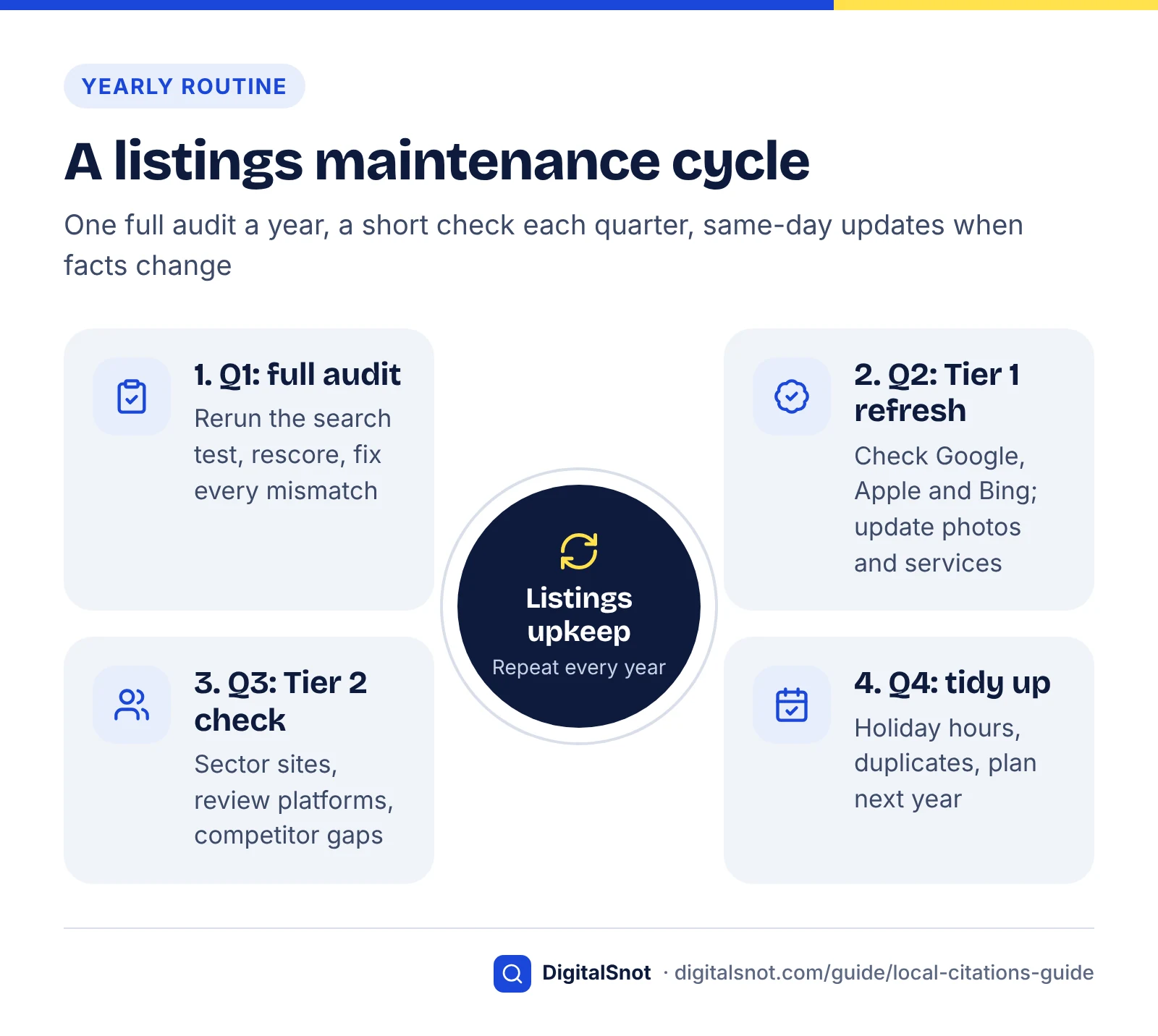
Keep citations accurate with one full audit a year, a short check each quarter, and an immediate update whenever a core fact changes. Listings drift: platforms accept user edits, import old data and create duplicates, so a clean audit does not stay clean on its own.
Quarter by quarter
- January to March, full audit: rerun the search test, update your scores and fix every mismatch in the audit sheet.
- April to June, Tier 1 refresh: check Google, Apple Business and Bing Places against your master record; update photos, services and special hours.
- July to September, Tier 2 and competitors: check sector sites, review platforms and, in India, Justdial and IndiaMART; add any platform that now passes the stopping rule.
- October to December, clean-up: set holiday hours, remove new duplicates and plan next year's outreach for earned mentions.
Events that cannot wait
A move, new phone number, rebrand, new location or closure: update Tier 1 the same day and everything else within a week. Do the same for an hours change lasting more than a few days, or a new service customers search for.
Measure what changed
Use free first-party reports first. Business Profile performance shows calls, direction requests and website clicks. Bing Webmaster Tools' AI Performance report shows how often your pages are cited in Copilot and Bing's AI answers, and our guide to the Search Console AI performance report explains Google's equivalent data and its limits. Track your mention rate across repeated local AI prompts, not single screenshots. Our checklist of what a monthly SEO report should include shows where listing work belongs.
If you would rather hand the audit and clean-up to a specialist, our local SEO service covers citations alongside Business Profile and review work, and you can contact us to talk through your listings.
Free tools in this guide
By the numbers
- of 6.8 million AI citations (ChatGPT, Gemini, Perplexity; local queries, July–August 2025) came from business listings
- 42%
- Source: Yext via Business Wire
- of OpenAI's (ChatGPT) citations came from listings in the same 2025 Yext study, against 42% across all three AI platforms
- 48.7%
- Source: Yext via Business Wire
- of local AI citations came from Google Business Profile, against 8.53% from Yelp
- 28.5%
- Source: BrightLocal
- of top-ten Google organic results for local-intent searches were business directories (about 8,000 results, October 2024)
- 31%
- Source: BrightLocal
Frequently asked questions
What is a local citation?
A local citation is any online mention of your business name, address and phone number, with or without a link. Structured citations are listings on platforms built for business data, such as Google Business Profile, Apple Maps, Bing Places, Yelp or Justdial. Unstructured citations are mentions inside other content, such as a local news story, a "best of" list or a trade association page. Both help search engines and AI tools confirm your details.
Do local citations still matter in 2026?
Yes, but for accuracy and AI answers more than map-pack rankings. Whitespark's 2026 expert survey found citation signals losing weight for Google's local pack, while three of the top five AI visibility factors were citation factors. Yext's study of 6.8 million AI citations from July and August 2025 found listings made up 42% of them. Correct listings on the right platforms matter; large numbers of low-quality directories do not.
Which business listings are most important?
Google Business Profile comes first, followed by Bing Places for Business and Apple Business, because they feed the maps and search tools built into Google, Microsoft and Apple products. Next comes the leading directory in your sector, such as Healthgrades, Checkatrade or Practo, which AI models rely on in specialist niches. Then add the review and local sites that appear when you search for your service and town.
How many citations does a local business need?
There is no fixed number. BrightLocal's 2018 study found businesses in first place in Google's local results averaged 86 citations against 75 in tenth place, and BrightLocal itself said the best benchmark is your local competitors. A practical rule is to be listed on Google, Apple and Bing plus every platform where at least two of your top three map-pack competitors appear, then focus on reviews and earned mentions.
What is NAP consistency and does it still matter?
NAP consistency means your business name, address and phone number appear exactly the same way on your website and every listing. It still matters because Google builds Business Profiles partly from crawled web content and licensed third-party data, and AI answers can repeat whichever version they find. Write one master record, then fix Google Business Profile first, followed by Apple Business, Bing Places and your sector sites.
What happened to Apple Business Connect?
Apple replaced Apple Business Connect with Apple Business, which launched on 14 April 2026 as a free service in the US and more than 200 countries and regions. Apple said existing Business Connect data, including claimed locations, place card information and photos, would migrate automatically. If you managed your Apple Maps listing before April 2026, sign in to Apple Business and check that your details came across correctly.
Do I need Bing Places if I already have a Google Business Profile?
Yes. Microsoft said in February 2026 that registering with Bing Places for Business helps keep your address, hours and contact details current and eligible for AI-generated responses. You can import from Google Business Profile, and Bing says verified Google listings usually publish within 7–12 days. Check for duplicates after importing, and note that synced listings are edited in Google and then re-synced.
Do Justdial and IndiaMART listings help in AI search?
Nobody has published data on it yet. We found no study measuring how often ChatGPT, Gemini, AI Mode or Perplexity cite Justdial, IndiaMART or Sulekha as of October 2026. Both platforms have large audiences, so claim and correct your listings for customers anyway. Then run your own test: ask AI tools for your service and city in the languages your customers use, and note which Indian sites they cite.
Should I pay for a citation-building service?
Only if it saves you time on platforms that matter. Avoid packages selling 100 or more directory submissions, because most of those sites have no visitors and no evidence of use by search engines or AI tools. A listings management tool can make sense for businesses with many locations. Before buying, check which platforms it covers in your country and ask what happens to your listings if you cancel.
How do I fix a duplicate Google Business Profile?
If you created the duplicate yourself and manage both profiles, remove the extra one, but check first which profile holds your reviews, because removing a profile deletes its content and linked managers. If you do not control the duplicate, follow Google's duplicate and ownership help to request access or report it. After a move, Google says to update the existing profile rather than create a new one.
Sources
Every figure and claim in this guide comes from the sources below. We checked each one when writing and link to the original so you can read it yourself. Credit belongs to the authors and publishers listed. How we write and check our articles.
-
1
Whitespark's Official 2026 Local Search Ranking Factors Report
Whitespark · 47 experts, 187 factors; citation signals dropped again for the local pack; 3 of top 5 AI visibility factors are citation factors.
-
2
Yext Research: 86% of AI Citations Come from Brand-Managed Sources
Yext via Business Wire · 6.8M AI citations (Jul–Aug 2025): listings 42%, websites 44%, forums 2%; OpenAI 48.7%; healthcare 52.6%.
-
3
Understand how Google sources & uses info in Business Profiles & local search results
Google Business Profile Help · Profile data comes from crawled web content, licensed third-party data, users and Google's own interactions.
-
4
Business Listings Visibility Study
BrightLocal · 15 Oct 2024, about 8,000 results: directories 31% of top ten; Yelp 28% of directory results; 37% informational, 72% fast food.
-
5
Where to get local citations for AI search
BrightLocal · Business Profile 28.5% of local AI citations, Yelp 8.53% (more on ChatGPT); specialist sites by sector.
-
6
Study: AI local search data
BrightLocal · Sep 2026: Maps 66% vs AI 32–38%; 20–33% repeat overlap; Business Profile key for AI Mode and AIO.
-
7
Introducing Apple Business — a new all-in-one platform for businesses of all sizes
Apple Newsroom · Launch on 14 April 2026, free; replaces Business Connect; data migrates; Maps ads in US and Canada.
-
8
Introducing AI Performance in Bing Webmaster Tools Public Preview
Microsoft Bing Webmaster Blog · Feb 2026: Copilot citation reporting; Bing Places keeps local details eligible for AI responses.
-
9
Sync your Google Business Profile
Bing Places for Business Help · Import from Google: auto-verification, 7–12 days to publish, duplicates, categories and editing limits.
-
10
Company Overview
Justdial · About 56.1M listings and 192.9M quarterly unique users (30 June 2026); free listing for owners.
-
11
Press Release April 30, 2026
IndiaMART InterMESH Limited · Q4 FY26: about 8.7M supplier storefronts and about 220,000 paying suppliers.
-
12
Guidelines for representing your business on Google
Google Business Profile Help · Real-world business name; no taglines, codes, hours, phones or URLs in the name; suspension risk.
-
13
Edit your Business Profile
Google Business Profile Help · Name changes may need re-verification.
-
14
Edit your Business Profile
Google Business Profile Help · Collected info under Edit profile: source and date of gathered data; delete entries; limited availability.
-
15
Resolve duplicate profiles & ownership issues
Google Business Profile Help · Remove accidental duplicates; do not create a new profile after relocating.
-
16
Mark your business as closed
Google Business Profile Help · Temporary vs permanent closure, special hours for short breaks, closed profiles still appear.
-
17
SEO Citations Study: How Many Citations Do Local Businesses Need?
BrightLocal · 2018 study of 122,125 businesses in 26 industries: 86 citations at position 1, 85 in the top three; no magic number.


