Guide · Keyword research and content
Prompt research: find the questions customers ask AI assistants
A free, repeatable method to collect the questions customers ask ChatGPT, AI Mode and Perplexity, sort them by intent and stage, and decide what to build first.

On this page (10 sections)
- 1What prompt research is, and what changes from keyword research
- 2Why you can't target exact prompts, and what to target instead
- 3Free sources of real customer questions
- 4Mine Search Console and Bing for conversational queries
- 5Classify prompts by intent and buying stage
- 6Build the prompt list: a template and a worked example
- 7Prioritise without prompt-volume data
- 8Turn prompt clusters into pages and test sets
- 9Keep the prompt library current
- 10Sources
Prompt research is the work of finding the questions your customers ask AI assistants such as ChatGPT, Google's AI Mode, Perplexity and Microsoft Copilot, then grouping them by what each person is trying to get done. It is the starting point for content that AI answers can use. It cannot simply copy keyword research, though, because nobody publishes prompt volumes and no two people word the same need alike.
The way people ask is changing fast. Google says the average AI Mode search is now triple the length of a traditional Search query (2026). OpenAI's 2025 study of how people use ChatGPT found that 49% of messages were "Asking": people seeking information or advice to help them make a decision. Those questions carry context, constraints and follow-ups that a two-word keyword never shows.
Who this is for: small-business owners and in-house marketers who know basic keyword research and want a repeatable way to collect, sort and prioritise conversational questions without paying for prompt data. What you'll be able to do: build a list of real customer questions from free sources, tag each one by intent and buying stage, score the clusters, and turn each cluster into a page, a section, an FAQ answer or a test prompt.
What prompt research is, and what changes from keyword research
Prompt research is keyword research for the full questions people type or speak into AI assistants. The customer needs behind them are the same. The unit of research changes, from a short phrase with a search volume to a cluster of long, context-rich questions that share one intent.
A keyword such as "physiotherapy Pune" tells you the topic. A prompt such as "I'm 52, I've had a frozen shoulder for two months and I live in Pune. How many physio sessions will I need?" tells you who is asking, what they have tried, where they are and what answer would satisfy them. That extra detail is the opportunity. It shows which page you need and what it must say.
Much stays the same. Google's guide to optimising for generative AI features (May 2026) says AI Overviews and AI Mode are rooted in Google's core ranking and quality systems and have no additional requirements. Good pages that answer real needs remain the foundation, and the methods in our keyword research guide still apply to the short versions of each question.
| Aspect | Keyword research | Prompt research |
|---|---|---|
| Unit you collect | A short phrase | A full question with context and constraints |
| Where the data comes from | Keyword tools, Search Console, autocomplete | Customers' own words, long Search Console queries, Bing grounding queries, forums |
| Demand data | Monthly search volume estimates | No public prompt volumes; proxies only |
| What you group by | Shared keyword and search results | Shared intent: what one good answer would satisfy |
| What success looks like | A ranking and a click | Being mentioned or cited across many runs, plus clicks where they happen |
Success changes because fewer searches now end in a click when an AI answer appears. Our post on how AI Overviews affect your traffic explains the click data and how to measure the change.
Why you can't target exact prompts, and what to target instead
You can't target exact prompts because people word the same need in completely different ways, and assistants rewrite the question before they search. Target the intent cluster instead: the group of prompts that one strong answer would satisfy.
The clearest evidence comes from SparkToro and Gumshoe's 2026 research. They asked volunteers to write prompts for the same underlying need, and the average semantic similarity of those prompts was 0.081, where higher scores mean closer wording. In plain terms, the prompts barely overlapped, so a keyword-style list of "the prompts we want to rank for" captures only a sliver of how people really ask.
The answers vary too. In the same research programme, 600 volunteers ran 12 prompts a combined 2,961 times, and SparkToro found less than a 1 in 100 chance that ChatGPT or Google's AI returns the same brand list twice in 100 runs. Yet across many phrasings, the set of brands that tended to appear was fairly stable. The lesson: measure whether you show up across a cluster of phrasings, as a rate, not whether you "rank" for one prompt.
Same need, very different prompts
The words that reach the index are often not the user's words
Assistants don't search with the prompt as typed. Google's generative AI guide describes query fan-out: the model issues related sub-queries to find more results. Bing is explicit about this in its AI Performance report documentation. Its grounding queries are "the key phrases the AI used when retrieving content", not the prompts people typed. So even perfect knowledge of one prompt would not tell you the searches it triggers.
Paid "prompt volume" data is modelled
Some tools now sell prompt topics or prompt volumes. Read how they are made. SparkToro, for example, explains that its AI prompt topics are estimated by an AI from the search keywords and other data it holds on an audience, not read from real prompt logs. That can be useful for ideas. It is not the same as measured demand, and other vendors' figures deserve the same scrutiny.
What to target instead
An intent cluster is a group of questions that share one underlying need and could be answered well by one page or one section. "Physio or chiropractor for back pain?", "I sit at a desk all day and my lower back aches, who should I see?" and "is a chiropractor better than physiotherapy" belong to one cluster. Your job is to find the clusters your customers care about, prove they are real, and make sure your answer to each is the clearest one available. Our guide to getting cited in AI search covers the page-level work once you know the clusters.
Free sources of real customer questions
The best sources are the ones where customers use their own words: sales and support conversations first, then search data, then public forums and Google's question features. AI assistants can suggest questions, but treat their lists as ideas to check, never as evidence.
Each source shows a different slice of demand. Using four or more types guards against the blind spots of any single one.
| Source | What it gives you | Blind spots | Effort |
|---|---|---|---|
| Sales calls, enquiry forms, WhatsApp and email | The exact words of people close to buying, with their constraints | Only people who already found you | Low once staff log questions |
| Support tickets and chat logs | Customer-stage and "how do I" questions | Few early-stage questions | Low |
| Reviews (yours and competitors') | What people wished they had known, in plain language | Not phrased as questions; you rewrite them | Medium |
| Reddit, Quora and niche forums | Unfiltered problem-stage wording and comparisons | Skews to certain ages and sectors | Medium |
| People also ask, autocomplete, related searches | Common question shapes and follow-ups on Google | Short, generic phrasing | Low |
| Search Console long queries | Real conversational queries that already show your pages, with impressions | Rare queries are hidden; only where you appear | Low |
| Bing Webmaster Tools grounding queries | Phrases Copilot used to retrieve your cited pages, with intent labels | Only where Copilot already cites you; sampled | Low |
| Asking an AI assistant for questions | Fast coverage of angles you missed | Plausible but invented; no evidence of demand | Very low |
Four free places to find real questions
Getting questions out of sales and support
Add one field to your enquiry log or CRM: "question in the customer's words". Ask front-desk and sales staff to note the questions they heard most this month, word for word, typos included. Ten real questions from people who nearly bought are worth more than a hundred from a tool.
Forums, reviews and People also ask
Search Google for site:reddit.com plus your service and words such as "recommend", "worth it" or "vs", then read how people describe the problem before they know your category's name. Read the three-star reviews of competitors for unanswered questions. Expand People also ask boxes two or three times, because each click loads follow-ups, and copy the follow-ups too.
Using AI assistants without fooling yourself
Asking ChatGPT "what questions do people ask about frozen shoulder physio?" produces a tidy list in seconds. Keep it, but mark each item's source as "AI-suggested" and give it zero evidence until a real source confirms it. Otherwise your plan reflects what a model guesses people ask, not what your customers ask.
Mine Search Console and Bing for conversational queries
Search Console shows how people word longer questions to Google, and Bing Webmaster Tools shows the phrases Copilot used to retrieve your pages. Together they are the closest free, first-party view of conversational demand, as long as you know what each leaves out.
Google's AI features documentation says AI Overviews and AI Mode traffic is reported in the Performance report under the Web search type. Google does not label which queries came from AI Mode, but the long, conversational queries in that report are the nearest thing to seeing how people phrase questions to Google.
Search Console, step by step
- Open Performance, then Search results, keep the Web search type and choose the longest date range available.
- Add a Query filter and choose Custom (regex). Google added regular expression filters to the Performance reports in 2021, using RE2 syntax.
- Run the patterns in the table below one at a time and export each result. Paste them into your sheet with the source "Search Console" and the impressions.
- Remove branded queries. Google introduced a branded queries filter in November 2025. Where you don't have it, add a second filter set to "Doesn't match regex" with your brand's spellings.
- Check Query groups if you see them. Since October 2025, Query groups in Search Console Insights cluster similar queries, including misspellings, rephrasings and other languages. They are computed by AI, can change over time and only appear for properties with a large volume of queries. Where you have them, they are a free first draft of your clusters.
| What you're looking for | Regex to paste | What it surfaces |
|---|---|---|
| Long queries (seven words or more) | ^(\S+\s+){6,}\S+$ | Conversational, prompt-like queries |
| Questions | ^(how|what|why|which|who|when|where|can|should|is|are|do|does)\b | Learning and problem-stage questions |
| First-person context | \b(i|i'm|im|my|we|our)\b | Queries where people describe their situation |
| Comparisons | \b(vs|versus|compare|compared|alternatives?|better than|difference between)\b | Comparing-stage questions |
| Cost and value | \b(cost|price|fees?|how much|worth it|cheap|affordable)\b | Commercial questions close to a decision |
| Recommendations and local | \b(best|top|recommend|near me|nearby)\b | "Which provider" questions; add your city names |
Keyword research table
What Search Console won't show you
- Rare queries are hidden. Google's deep dive on performance data explains that anonymised queries, those not issued by more than a few dozen users over two to three months, are left out of the tables. Many long prompts are exactly that rare, so what you see is a sample of the long tail.
- Only queries where you appeared. If your site never showed for a question, it is not in your report. That is why sales and forum sources matter.
- Row limits. The Performance report's tables show at most 1,000 rows, as the same deep dive explains. Larger sites can use the Search Console API or bulk data export to see more rows.
- The AI report has no queries. Search Console's generative AI performance report breaks impressions in AI Overviews and AI Mode down by page, country, device and date, with no query dimension. Use it to see which pages appear in AI features, as our Search Console AI performance report guide explains, not to find prompts.
Bing Webmaster Tools: grounding queries, intents and topics
Bing's AI Performance report, in public preview since February 2026, lists the grounding queries behind your citations in Copilot and Bing's AI summaries. Treat them as retrieval phrases rather than prompts. They show how the AI turned questions into searches that found your pages, which is useful when you write headings and sections.
Two newer additions make it even more useful for prompt research:
- Intents (June 2026). Bing's AI visibility update classifies grounding queries into categories that include Informational, Commercial, Navigational, Learn and Solve, Research, Creation and Local. The same update added Citation Share: your share of all citations shown for a grounding query. Bing says it is observational, not a ranking.
- Topics Portfolio (beta, October 2026). Topics Portfolio groups the grounding queries where your site appears into thematic clusters and suggests opportunity queries. Its Topic Size column is the approximate total citations across all sites for a topic, which Bing presents as a measure of how much AI search demand the topic represents. That is the closest thing to a first-party AI demand figure available today (checked October 2026).
The limits: Bing describes the data as a sample, Topics Portfolio appears only when Bing has enough data for your site, and you need some Copilot citations before there is anything to see.
Classify prompts by intent and buying stage
Tag every question twice: once for intent, the job the person wants done, and once for stage, how close they are to buying. Intent decides the format of the page that answers it. Stage decides how much the question is worth and what the next step on the page should be.
How the main intent frameworks compare: our analysis
Method: in October 2026 we lined up the categories in OpenAI's 2025 ChatGPT usage study, the Intents labels in Bing's June 2026 announcement, the labels in our free AI Prompt Intent Classifier and the classic four-way SEO split. None of these sources publishes a crosswalk, so the mapping in each row is our judgement. Bing lists its categories as examples, so it may use more.
| Customer's job | Classic SEO label | OpenAI usage study (2025) | Bing Intents (2026) | Our classifier |
|---|---|---|---|---|
| Understand a topic or problem | Informational | Asking | Informational | Informational |
| Fix something step by step | Informational | Asking, or Doing if the assistant does it | Learn and Solve | Informational |
| Weigh up options | Commercial | Asking | Research, Commercial | Comparison, Commercial research |
| Get a recommendation ("best X for Y") | Commercial | Asking | Commercial | Recommendation |
| Buy, book or hire | Transactional | Asking or Doing | Commercial (closest) | Transactional |
| Find a provider nearby | Usually transactional | Asking | Local | Local |
| Reach or check a known brand | Navigational | Asking | Navigational | No separate label |
| Have something made (write, plan, calculate) | No equivalent | Doing | Creation | No separate label |
| Share feelings or think aloud | No equivalent | Expressing | None listed | No separate label |
What the comparison shows
- Classic SEO has no slot for "doing". OpenAI found Doing in 40% of ChatGPT messages, and Bing has a Creation label. These are tasks the assistant completes itself, so a page rarely wins them. The exceptions are tasks that need your data, a template or a tool.
- "Expressing" is rarely a business opportunity. At 11% of messages in OpenAI's study, it is real usage, but it is not where customers look for providers. Drop these from your list.
- "Commercial" splits into three jobs. Comparing, checking costs and asking for a recommendation each need a different answer format: a criteria table, a price guide and a proof-led service page backed by third-party mentions.
- Location is a modifier, not only an intent. "Cost of physio in Pune" and "best physio in Pune" are both local but need different pages. Bing and our classifier treat Local as its own label, so we add a separate location column as well.
The tag set to use
Use eight intent tags, each with a hypothetical example from a physiotherapy clinic:
- Learn: "Why does my lower back hurt after sitting all day?"
- Solve: "What stretches help a stiff neck from laptop work?"
- Compare: "Physio or chiropractor for desk-job back pain?"
- Cost: "How much does a physio session cost in Pune, and is home treatment more?"
- Recommend: "Which physio near Baner is good for sports injuries?"
- Book: "Physio in Pune with Sunday appointments."
- Brand check: "Is [clinic name] good for ACL rehab?"
- Do: "Write me a four-week home exercise plan for a frozen shoulder."
Then add one of five stages. Problem-aware people know the symptom but not the solution. Solution-aware people know the options exist. Comparing people are weighing approaches or providers. Ready people are choosing and booking. Customers have already bought and need help using what they bought.
To speed up the first pass, paste up to 50 questions into the free AI Prompt Intent Classifier. It labels each one as recommendation, transactional, local, commercial research, comparison or informational, gives it a business value score and shows the kind of page that tends to win it. It works from wording patterns, so check anything it calls informational that you know is a buying question, and add the stage yourself.
Build the prompt list: a template and a worked example
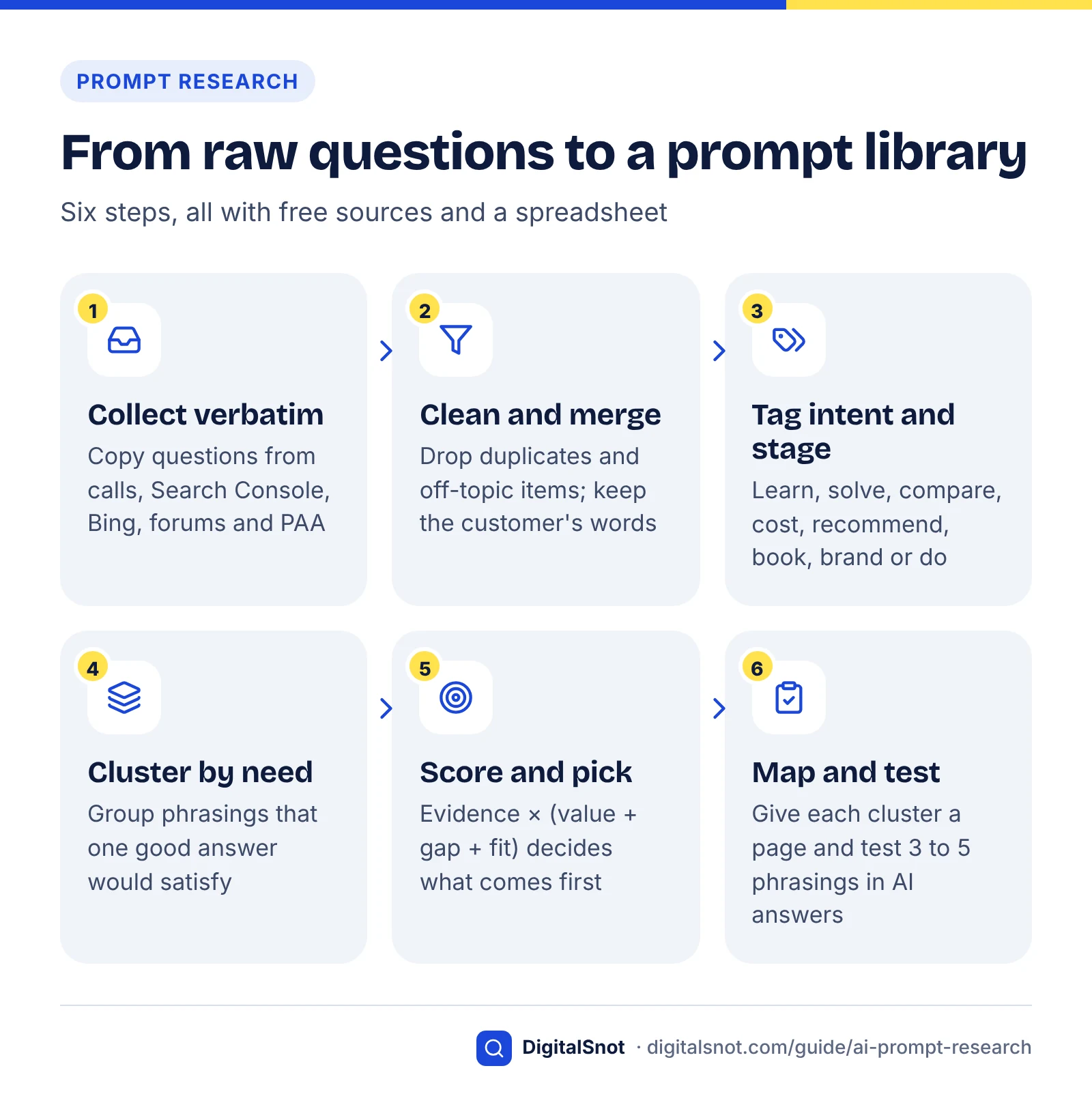
Keep one row per real question, with the customer's exact words, where it came from, a rewritten prompt, its tags, its cluster and how many independent sources show it. A spreadsheet is enough. The structure matters more than the tool.
The template
| Column | What goes in it |
|---|---|
| ID | A short code, such as P-014 |
| Verbatim | The customer's exact words, typos included |
| Source and date | Where you found it and when, such as "WhatsApp enquiry, September 2026" |
| Prompt version | The full question as someone would put it to an assistant, with the context they would add |
| Intent and stage | One intent tag and one of the five stages |
| Location | The place named, or blank |
| Cluster | A short name for the shared need |
| Evidence | How many different source types show this cluster |
| Current page | The URL that answers it now, or "none" |
Worked example: a physiotherapy clinic in Pune
Example (hypothetical): a two-site physiotherapy clinic in Pune spends one afternoon collecting questions. Its raw inputs include:
- A call note: the caller asked whether to see a physio or a chiropractor for back pain from sitting all day.
- A WhatsApp message: "how many sesions for frozen shoulder".
- Search Console queries with impressions but few clicks: "physio or chiropractor for lower back pain from sitting", "how many physiotherapy sessions are needed for frozen shoulder", "physiotherapy charges per session pune" and "acl rehab physio near baner".
- People also ask questions: "Is a chiropractor or a physiotherapist better for back pain?" and "How long does frozen shoulder take to heal with physiotherapy?"
- A city subreddit thread: "Any good physio near Baner for ACL rehab after surgery?"
- A competitor's review: "wish I'd known they do home visits for elderly patients".
- A Bing grounding query: "physiotherapy home visit pune".
- Front-desk notes: "What do you charge per session?" and "Do I need a doctor's referral?"
- An AI assistant's suggestion, logged with zero evidence: "home exercise plan for frozen shoulder".
After merging rewordings, the clinic's grouped list looks like this:
| Cluster | Example prompt (rewritten with context) | Intent | Stage | Evidence |
|---|---|---|---|---|
| Physio vs chiropractor for desk-job back pain | "I sit at a desk all day and my lower back aches. Should I see a physio or a chiropractor?" | Compare | Comparing | 3 |
| Frozen shoulder: sessions and recovery | "How many physio sessions does a frozen shoulder usually need, and when can I lift my arm again?" | Learn | Solution-aware | 3 |
| Cost per session in Pune | "How much does physiotherapy cost per session in Pune, and is a home visit more expensive?" | Cost (local) | Ready | 2 |
| Home physio for elderly parents | "My 78-year-old father can't travel after a hip operation. Is there a physio in Pune who does home visits?" | Recommend (local) | Ready | 2 |
| ACL rehab near Baner | "I had ACL surgery six weeks ago. Which physio near Baner specialises in sports rehab?" | Recommend (local) | Ready | 2 |
| Referral needed | "Do I need a doctor's referral to book a physiotherapist in India?" | Learn | Ready | 1 |
| Home exercise plan | "Write me a four-week home exercise plan for a frozen shoulder." (AI-suggested) | Do | Customer | 0 |
Rules for rewriting a question as a prompt
- Keep the customer's words. Change grammar only where you must. Their vocabulary ("sessions", "home visit") is what your page should use.
- Add the context people give assistants. Age, situation, what they tried, budget, deadline and place. Only add context you have seen in real questions.
- One need per prompt. If a question asks two things, split it, and the parts may land in different clusters.
- Merge true rewordings, not neighbours. "What do you charge per session?" and "physiotherapy charges per session pune" are one cluster. "Physio cost" and "is physio worth it" are two, because they need different answers.
Prioritise without prompt-volume data
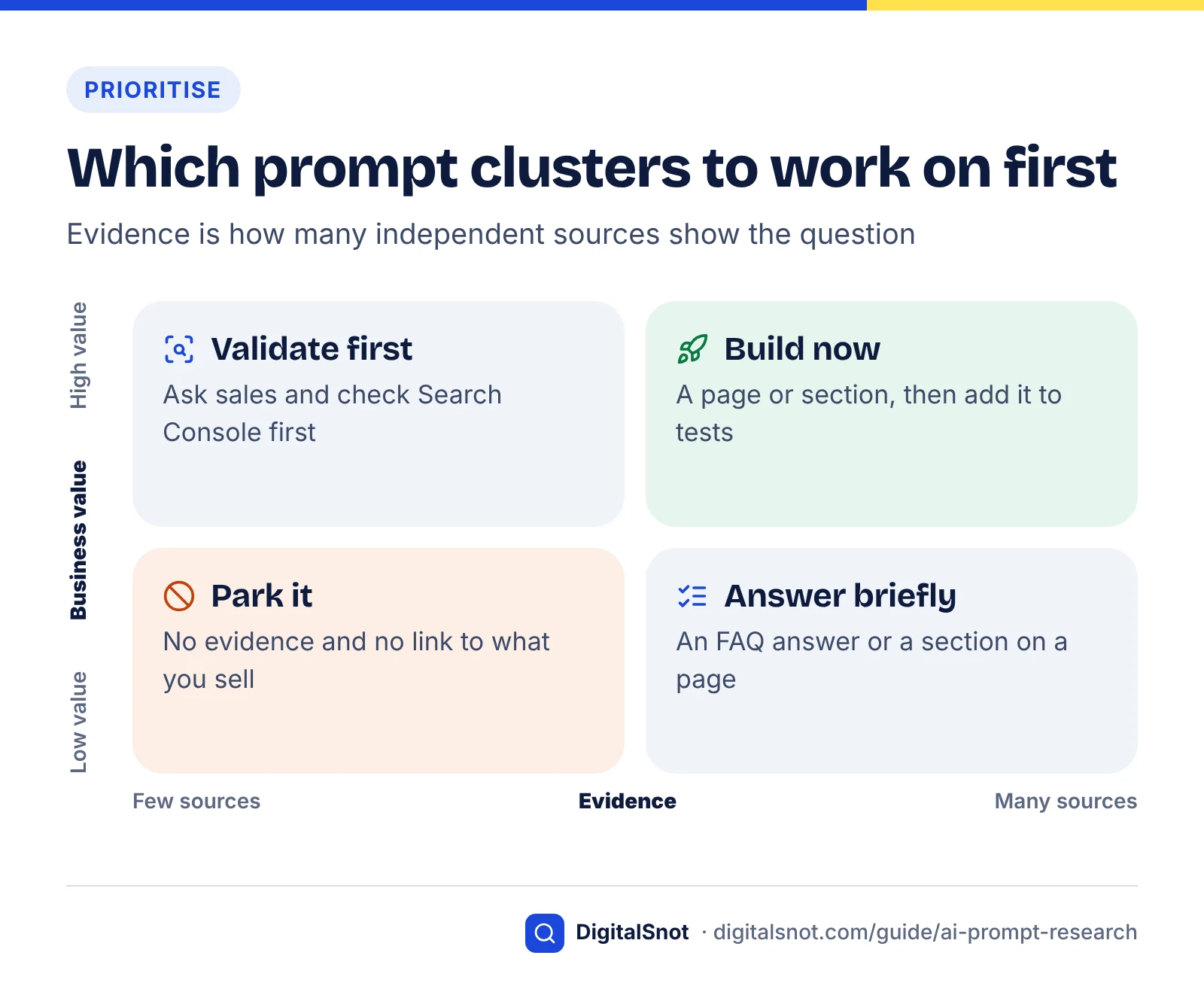
Without prompt volumes, rank clusters by how much evidence shows people ask them, then by how valuable, unanswered and winnable they are for you. Make evidence a multiplier, so a cluster nobody actually asks scores zero however attractive it looks.
Demand proxies you already have
- Search Console impressions summed across a cluster's queries, including its short keyword versions.
- Bing Topic Size for the matching topic, where Topics Portfolio shows one.
- How often sales and support hear it each month.
- How many independent places it appears: People also ask, forum threads and reviews.
- Keyword volume for the short version, as a rough guide to interest in the topic, not the prompt.
The scoring framework
Score each cluster from 0 to 3 on four factors, then calculate Priority = Evidence × (Value + Gap + Fit). The maximum is 27.
| Factor | 0 | 1 | 2 | 3 |
|---|---|---|---|---|
| Evidence: source types showing it | Only a guess or an AI suggestion | One | Two | Three or more |
| Value: closeness to what you sell | Unrelated | Learning | Comparing | Choosing or booking |
| Gap: how well it is answered now | You are already cited or rank near the top | Your page exists but is not cited | Competitors are cited, you have no answer | Nobody answers it well |
| Fit: can you give a non-commodity answer? | Only common knowledge | Some expertise | Clear expertise | First-hand data, process, prices or local detail |
"Non-commodity" is Google's word, from its May 2026 guide, for content with expert or first-hand insight that goes beyond common knowledge. To score Gap, run two or three phrasings from the cluster in ChatGPT, AI Mode and Perplexity, and note who is cited.
Worked calculation (hypothetical clinic)
| Cluster | Evidence | Value | Gap | Fit | Priority |
|---|---|---|---|---|---|
| Physio vs chiropractor | 3 | 2 | 2 | 3 | 3 × 7 = 21 |
| Cost per session in Pune | 2 | 3 | 3 | 3 | 2 × 9 = 18 |
| Home physio for elderly parents | 2 | 3 | 2 | 3 | 2 × 8 = 16 |
| Frozen shoulder sessions | 3 | 1 | 1 | 3 | 3 × 5 = 15 |
| ACL rehab near Baner | 2 | 3 | 1 | 2 | 2 × 6 = 12 |
| Referral needed | 1 | 1 | 2 | 2 | 1 × 5 = 5 |
| Home exercise plan (Do) | 0 | 1 | 1 | 1 | 0 × 3 = 0 |
Our rule of thumb: 15 or more, build or rebuild a page now; 8 to 14, add a section or FAQ answer, or collect more evidence first; under 8, park it. The multiplier rewards evidence: one more real source can move a cluster up a whole band, so an hour with the front desk often changes the plan.
Should you pay for prompt-volume data?
Only once the free sources are exhausted, and only after asking the vendor four questions. Where does the data come from: a panel, clickstream, or prompts generated by a model? Which countries and languages does it cover? How are prompts grouped into topics? Can you see the sample size behind a number? If the answers are vague, treat the figures as ideas, the same as an AI-suggested list.
Turn prompt clusters into pages and test sets
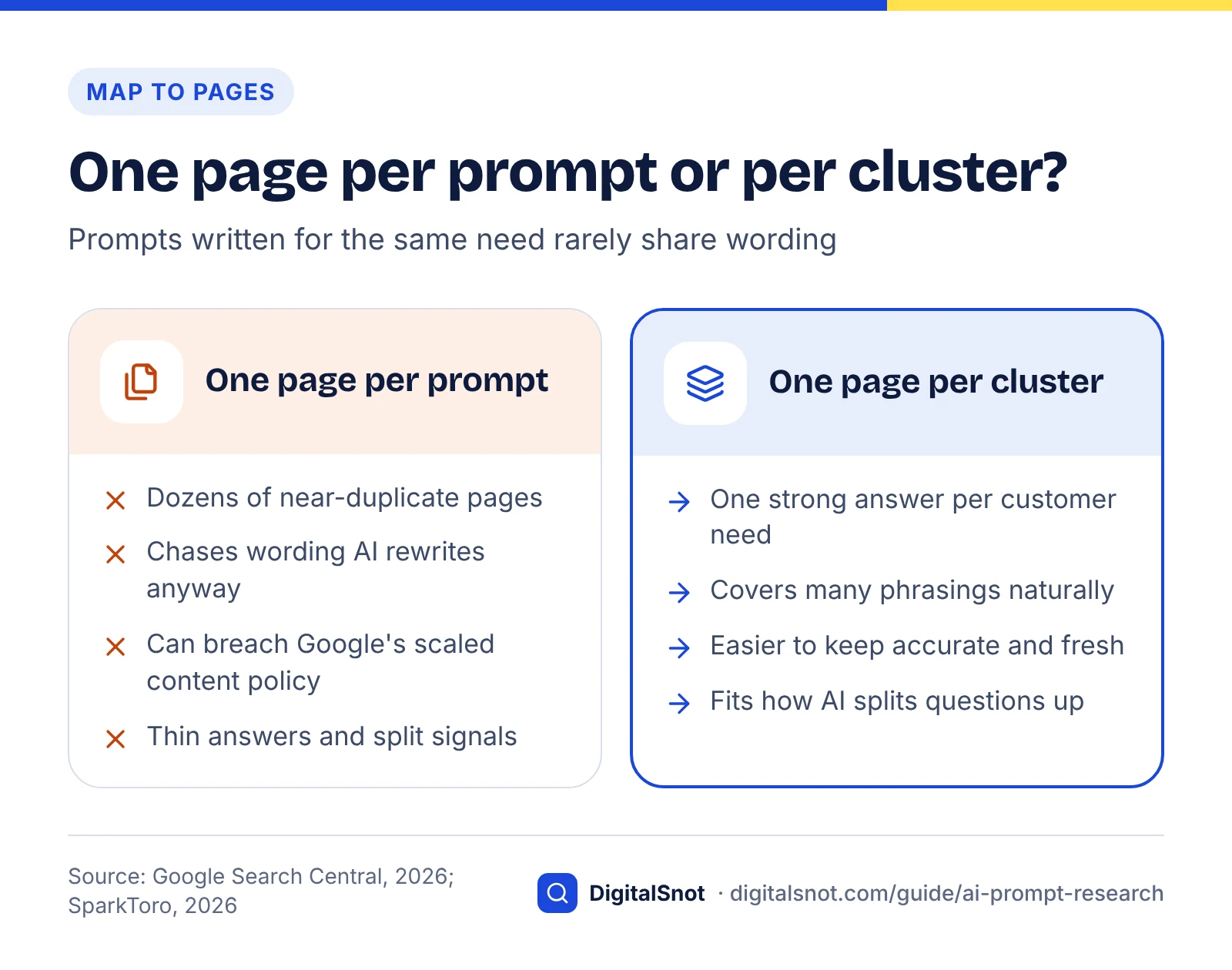
Give each priority cluster one home: a page or a section chosen by its intent. Then pick three to five real phrasings from the cluster as your test set, so you can see whether AI answers start to mention or cite you.
Don't create a page for every phrasing. Google's generative AI guide warns that making separate pages for every query variation, mainly to manipulate rankings, breaches its scaled content abuse policy. One strong page per cluster covers many phrasings naturally, because it answers the shared need. If you are unsure whether a cluster deserves its own URL or a section, our post on service pages versus blog posts sets out how to decide.
Decision table: what each cluster needs
| If the cluster is… | Then build or fix… | And avoid… |
|---|---|---|
| Learn, with one short answer (e.g. referral needed) | An answer-first section or FAQ answer on the most relevant existing page | A thin standalone page |
| Learn or Solve, with depth (e.g. frozen shoulder sessions) | A guide with steps, typical timelines and the factors that change the answer | Generic definitions every page already has |
| Compare (e.g. physio vs chiropractor) | A comparison page: criteria table, a verdict for each type of person, honest trade-offs | A comparison you always win |
| Cost | A cost guide with ranges, what changes the price and what is included | "Contact us for prices" when you could publish ranges |
| Recommend ("best X for Y") | A service page with proof, plus mentions on the third-party pages AI already cites | A self-ranked "best" list that puts you first |
| Local (near me, a city or an area) | A complete Google Business Profile, a location or service page, reviews that mention the service | One page per suburb with only the place name swapped |
| Brand check ("is [you] good", "[you] prices") | Consistent facts on your site and listings; clear About, pricing and FAQ pages | Ignoring what listings and reviews say about you |
| Do or Create (write, plan, calculate) | A tool, template or data only if the assistant cannot do the task without you | A blog post aimed at a task the assistant completes itself |
| Expressing or off-topic | Nothing: drop it | Keeping it "just in case" |
For recommendation clusters, it helps to understand how ChatGPT chooses which businesses to recommend. For local clusters, our guide to local SEO for AI search covers Google Business Profile, Ask Maps and reviews.
Check what already gets cited before you write
Run one or two phrasings from the cluster in ChatGPT, Perplexity or AI Mode and copy the pages the answer links to. Paste them into the free Cited Content Pattern Analyzer. It classifies each cited page's format (list, how-to, comparison, pricing guide and so on) and measures length, question headings, tables, sources and freshness, so you can see the format that wins that cluster. If one competitor page keeps being cited instead of yours, the AI Citation Gap Checker compares the two pages factor by factor and shows the gaps to close first. Then write the page, using our on-page SEO checklist for titles, headings and internal links.
Build a test set from the same clusters
- Take your highest-scoring clusters, usually 8 to 15 for a small business.
- Choose three to five phrasings per cluster that differ: a short keyword-style one, a long one with context, a comparison and, where relevant, a local one. Use wording from your sheet, not your own.
- Run each phrasing in ChatGPT with search, AI Mode, Perplexity and Copilot, in a signed-out or fresh session, and note the location you ran it from.
- Record four things: whether you are mentioned, whether your site is cited, which URL is cited and which other sources appear.
- Repeat the runs and report a rate, the share of runs where you appear. Single runs mislead, given SparkToro's finding that brand lists almost never repeat.
- Freeze the set for at least a quarter, so changes in your rate reflect your work, not new wording.
Keep the prompt library current
Treat the prompt library as a living document: add questions as they arrive, refresh search exports monthly, and re-score clusters and re-run the test set each quarter. Customer questions change with seasons, prices and new products, and AI answers change faster still.
A simple cadence
| When | What to do | Output |
|---|---|---|
| Ongoing | Sales and support log new questions in the customer's words | New rows in the sheet |
| Monthly | Re-run the Search Console regex filters and export Bing grounding queries; tag new rows | New or growing clusters flagged |
| Quarterly | Re-score clusters, check Bing Intents and Topics Portfolio, re-run the frozen test set, refresh pages | Updated priorities and a mention-rate trend |
| On a trigger | New service, price change, seasonal peak, or a competitor suddenly cited | A targeted mini-round of research |
Report the trend alongside your usual SEO numbers. Our checklist of what to look for in a monthly SEO report shows where AI visibility fits.
Mistakes to avoid
- Treating AI-generated question lists as evidence. They show what a model guesses, not what your customers ask.
- Tracking one "ideal" prompt. With same-need prompts this dissimilar, one prompt measures almost nothing.
- Weighting the list towards learning questions. They are the easiest to find but the furthest from a sale, so make sure comparing and ready-stage clusters are well represented.
- Forgetting customer-stage questions. "How do I…" questions after purchase drive reviews, referrals and repeat business.
Prompt research is not a new discipline so much as listening to customers with better tools. Collect their words, group them by the job they want done, prove each cluster is real, and give every important cluster the clearest answer on the web. If you want help turning a prompt library into pages that get cited, that is the core of our content SEO service, and our AI search optimisation work covers tracking and citation gaps. When you are ready, talk to us about your prompt research.
Free tools in this guide
By the numbers
- average semantic similarity of prompts that volunteers wrote for the same need (SparkToro and Gumshoe, 2026)
- 0.081
- Source: SparkToro
- chance that ChatGPT or Google's AI gives the same brand list twice when asked 100 times (2,961 runs, 600 volunteers)
- <1 in 100
- Source: SparkToro
- of ChatGPT messages were "Asking" (seeking information or advice), against 40% "Doing" and 11% "Expressing" (OpenAI, 2025)
- 49%
- Source: OpenAI
- the average AI Mode search is triple the length of a traditional Google Search query (Google, 2026)
- 3x
- Source: Google
Frequently asked questions
What is prompt research?
Prompt research is the process of finding the questions customers ask AI assistants such as ChatGPT, Google AI Mode, Perplexity and Copilot, and grouping them by intent and buying stage. Because people word the same need very differently, the output is a set of intent clusters rather than a list of exact prompts. Each cluster then gets a page or section and a few test phrasings for tracking AI mentions.
How is prompt research different from keyword research?
Keyword research collects short phrases with search volume estimates and groups them by shared results. Prompt research collects full questions with context, such as age, budget, location and what someone already tried, and groups them by shared intent. There are no public prompt volumes, so prompt research relies on evidence from several free sources and measures success as mention and citation rates rather than rankings.
Can I see the exact prompts people type into ChatGPT?
No. OpenAI does not give site owners the prompts people type, and Google does not label which Search Console queries came from AI Mode. The closest free signals are long, conversational queries in Search Console, the grounding queries in Bing Webmaster Tools, and the questions customers ask your sales and support teams in their own words. Combine several of these sources rather than relying on one.
Is there any search volume data for AI prompts?
There is no first-party prompt volume from OpenAI or Google. Some paid tools sell prompt topics or volumes, but many are modelled; SparkToro says its prompt topics are estimated by an AI from keyword and audience data. The nearest first-party figure is Topic Size in Bing's Topics Portfolio beta (October 2026), an approximate count of citations across all sites for a topic.
What are Bing grounding queries?
Grounding queries are the key phrases Bing's AI used when retrieving content that was cited in Copilot or Bing AI answers. They appear in the AI Performance report in Bing Webmaster Tools, in public preview since February 2026. They are not the prompts people typed, and the data is a sample. Since June 2026 Bing also labels them by intent, such as Informational, Commercial or Local.
Should I create a separate page for every prompt?
No. Google's May 2026 guide to generative AI features warns that creating pages for every query variation, mainly to manipulate rankings, breaches its scaled content abuse policy. Prompts for the same need rarely share wording anyway, so one strong page or section per intent cluster covers far more real phrasings than dozens of near-duplicate pages, and it is much easier to keep accurate.
How many prompts should a small business track?
As a rule of thumb, pick 8 to 15 priority clusters and three to five varied phrasings for each, giving roughly 25 to 75 test prompts. Run each in ChatGPT with search, AI Mode, Perplexity and Copilot, repeat the runs, and report the share of runs where you are mentioned or cited. Keep the set unchanged for at least a quarter so trends are comparable.
How do I find conversational queries in Search Console?
In the Performance report, add a Query filter, choose Custom (regex) and paste a pattern such as ^(\S+\s+){6,}\S+$ to list queries of seven words or more. Run separate patterns for question words, comparisons, costs and first-person phrases like "my" or "I'm". Remember that rare queries are anonymised and left out of the tables, so what you see is only a sample of long questions.
What free tools help with prompt research?
Start with Search Console (regex filters and Query groups), Bing Webmaster Tools (grounding queries, Intents and Topics Portfolio), People also ask and forums. Our free AI Prompt Intent Classifier sorts up to 50 questions by intent and value, the Cited Content Pattern Analyzer shows the format of pages AI cites, and the AI Citation Gap Checker compares your page with a cited competitor.
How often should I update my prompt list?
Add new questions continuously as sales and support hear them, refresh Search Console and Bing exports monthly, and re-score clusters and re-run your test set every quarter. Also run a quick round of research when you launch a service, change prices, enter a seasonal peak or notice a competitor suddenly being cited. Keep the core test set fixed for a quarter at a time.
Sources
Every figure and claim in this guide comes from the sources below. We checked each one when writing and link to the original so you can read it yourself. Credit belongs to the authors and publishers listed. How we write and check our articles.
-
1
How AI Mode is changing and expanding the way people search
Google · Average AI Mode search is triple the length of a traditional Search query (2026).
-
2
How people are using ChatGPT
OpenAI · Asking 49%, Doing 40%, Expressing 11% of ChatGPT messages (2025 usage study).
-
3
Optimizing your website for generative AI features on Google Search
Google Search Central · No extra requirements; query fan-out; non-commodity content; pages per variation and scaled content abuse.
-
4
Why Everyone Prompts AI Differently (Even When They Want the Same Thing)
SparkToro · Same-need prompts had an average semantic similarity of 0.081.
-
5
NEW Research: AIs are highly inconsistent when recommending brands or products; marketers should take care when tracking AI visibility
SparkToro · 600 volunteers, 2,961 runs; under 1 in 100 chance of the same brand list twice.
-
6
Introducing AI Performance in Bing Webmaster Tools (public preview)
Bing Webmaster Blog · Grounding queries are key phrases used in retrieval, not user prompts; sampled data.
-
7
NEW in SparkToro: Uncover the AI Prompt Topics Your Audience is Using in ChatGPT, Google AI Mode, Claude, and more
SparkToro · Example of vendor prompt topics estimated by AI from keyword and audience data.
-
8
AI features and your website
Google Search Central · AI Overviews and AI Mode traffic is reported under the Web search type.
-
9
Improved data filtering and comparison on Performance reports
Google Search Central Blog · Regex filters for queries and pages in Search Console (April 2021).
-
10
Introducing the branded queries filter in Search Console
Google Search Central Blog · Branded queries filter announced November 2025.
-
11
Introducing Query groups in Search Console Insights
Google Search Central Blog · AI-computed groups of similar queries; large properties only (October 2025).
-
12
A deep dive into Search Console performance data filtering and limits
Google Search Central Blog · Definition of anonymised queries, why they are omitted from tables, and row limits.
-
13
Generative AI performance report (Search)
Search Console Help · Dimensions of the AI report: page, country, device and date, with no query dimension.
-
14
New AI Visibility Insights in Bing Webmaster Tools: Intents, Topics, Citation Share, Compare
Bing Blogs · Intent categories for grounding queries and the Citation Share metric (June 2026).
-
15
Introducing Topics Portfolio (Beta) in AI Performance
Bing Webmaster Blog · Thematic clusters of grounding queries and Topic Size as an AI demand measure (October 2026).